
Holdout Groups for Measuring AI Tool Revenue Lift in DTC
Holdout groups measure true AI lift by comparing shoppers who see the tool against those who don't.
Customer acquisition costs have risen sharply from 2023 to 2025, breaking the paid arbitrage model that funded growth for a decade. The average brand now loses money on the very first order it books. Retention has to carry the business because acquisition no longer pays for itself. At the same time, 84% of ecommerce businesses have made AI their top strategic priority, so most brands are pouring budget into these tools at the exact moment their room for error has shrunk to almost nothing. Executives believe in the promise: 65% say AI and predictive analytics will drive growth, but belief isn't measurement, and a brand can be fully convinced of something that isn't actually true. When every tool in the stack claims credit for revenue and margin is already thin, a false positive on AI lift doesn't just look bad on a slide, it means money gets moved toward a tool that isn't earning it.
How attribution systems systematically over-report what AI tools contribute
The math doesn't work when platforms collectively claim credit for revenue that adds up to more than the brand actually made. That's the starting point for understanding why so much of what passes for measurement in ecommerce is really just a collection of overlapping, self-interested guesses. Meta Ads Manager has lost between 15% and 30% of its attribution visibility, Google Analytics 4 struggles badly with anyone who switches devices mid-journey, and brands spending real money on ads now watch 20% to 40% of their conversions get labeled "unknown source," even when the order clearly happened. Last-click models make this worse in a specific direction: they hand credit to whichever channel touched the sale last, usually email, direct traffic, or branded search, while shortchanging the channels that did the actual work of building interest earlier on. An AI chatbot that engages someone early in their research gets stiffed by this logic, or it swings the other way entirely and gets full credit for a sale that customer was always going to make.
That second failure mode is the one that matters most for AI tools specifically. An on-site AI tool that engages shoppers who were already nearly committed to buying will show strong "assisted conversion" numbers in any dashboard, but those numbers are correlation. Those numbers describe what happened alongside the sale, not what caused it. Correlation dressed up as causation is still correlation, and no amount of dashboard polish changes that.
What holdout groups measure
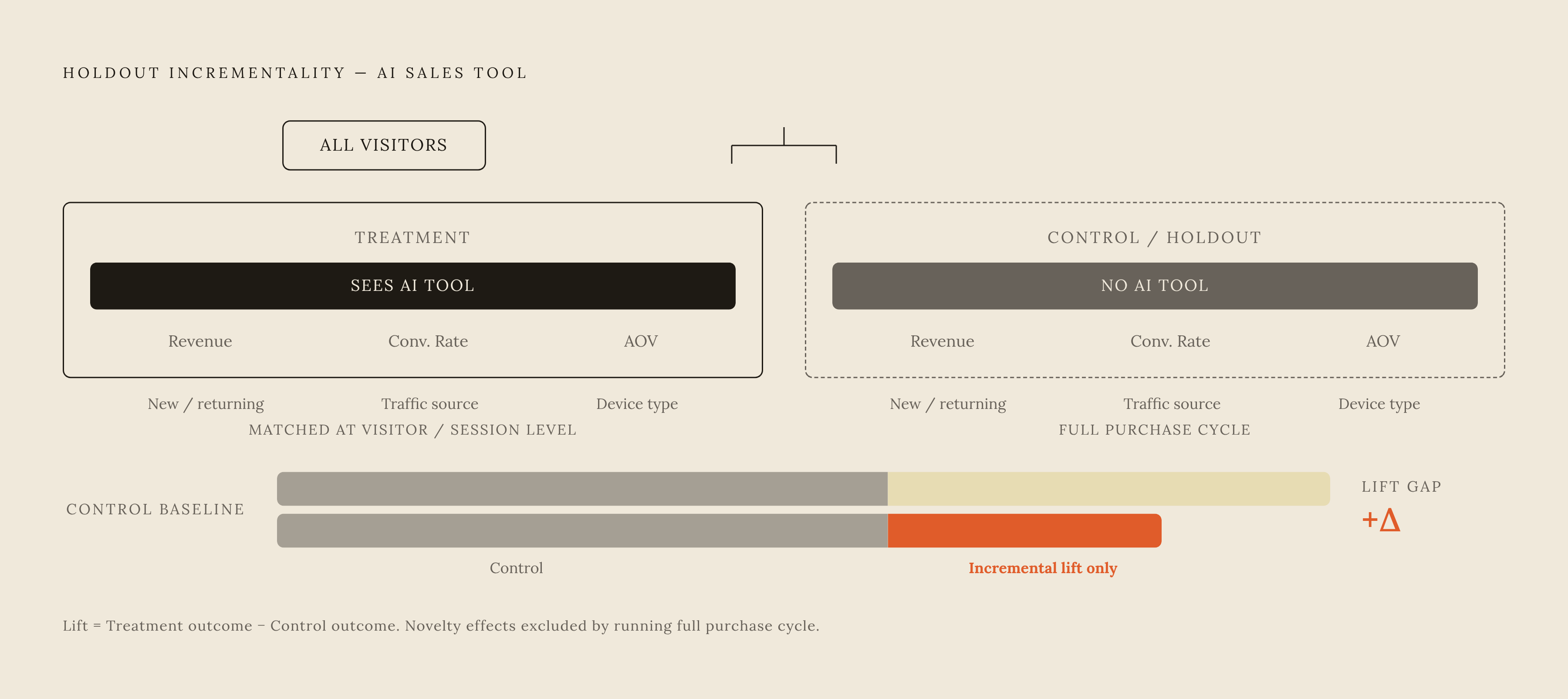
The fix starts with a concept borrowed from clinical research: the counterfactual, a credible estimate of what would have happened if the tool had never been switched on. An incrementality experiment doesn't ask how much revenue touched the AI tool. Holdout groups, geo tests, and conversion lift studies all produce this counterfactual in different ways, and any dashboard that claims to show "contribution" from raw observational data is showing a model's guess, not a measurement of what actually happened.
Applied to an AI sales tool, the method is straightforward to describe: split shoppers into a group that sees the AI experience and a matched group that does not, then measure revenue, conversion rate, and AOV across both, with the difference (net of what the control group did on its own) being the genuine lift. Track revenue, conversion rate, and average order value across both groups over the same window. Whatever difference remains after accounting for what the control group did entirely on its own is the real lift, the revenue the tool actually created rather than merely appeared next to.
It sounds simple next to something like testing a button color, and conceptually it is, but the execution is harder. The holdout group needs enough volume to reach statistical significance, it needs to be matched on the traits that actually predict purchase behavior (new versus returning, traffic source, device type, product category), and it needs to stay clean long enough to capture a full purchase cycle rather than a partial one. The IAB's 2025 Guidelines for Incremental Measurement in Commerce Media organize the whole discipline around three requirements, a credible counterfactual, control of bias, and separation of real signal from statistical noise. Those three requirements are the backbone of every design decision that follows.
Designing a holdout test for an on-site AI tool: the variables that determine whether results are trustworthy
Assignment has to happen at the visitor or session level, at random, never at the level of a pre-existing behavioral segment. Segment-level assignment smuggles selection bias into the test before it even starts, because the shopper who ends up in one segment already differs from the shopper who ends up in another.
Matching variables deserve more attention than they usually get, especially for AI tools. New-versus-returning customer status decides whether the test tells the truth: 85% of AI-referred revenue in Ethercycle's 24-month dataset came from first-time buyers, so a holdout group heavy with returning customers will understate lift if the tool's real strength is with new visitors. Traffic source matters just as much. Visitors who arrive from ChatGPT, Perplexity, or Gemini tend to be pre-sold before they ever land on the site, and they convert at a higher baseline rate than the average visitor.
A high-AOV brand with a longer consideration cycle needs more time in test than a brand selling something people buy on impulse and repurchase in weeks, because cutting the test short risks measuring an incomplete purchase decision rather than the true one.
Self-selection is the quiet killer of otherwise well-built tests. If shoppers can opt into using the AI tool, then the people who engage with it are not the same population as the people who ignore it, full stop. Engagement signals intent to buy; it doesn't prove the tool created that intent. A trustworthy design assigns exposure to the AI experience itself, at random, rather than comparing people who chose to click something against people who didn't.
Volume sets a hard floor under all of this. Statistical significance needs enough conversions in both arms of the test, and brands running under roughly $50,000 in monthly ad spend often don't have the traffic to produce a clean read; for those brands, the test may need a narrower scope, a single high-traffic page or a single segment, rather than a site-wide holdout. Finally, conversion rate alone tells an incomplete story. Average order value, return rate, and repeat purchase rate over both the short and medium term all belong in the same report, because a tool that lifts the first sale while quietly inflating returns or suppressing the second purchase isn't adding revenue at all, it's borrowing it.
Reading the results: what genuine lift looks like versus statistical noise
High-performing DTC brands running AI-driven incrementality testing have reported revenue lift in the range of 18% to 26% compared to standard holdout methods, a useful benchmark to hold in mind, though never a guarantee for any individual test. Attribution.ai, for instance, attaches a confidence interval to every number that comes out of its media mix models, incrementality tests, and post-purchase surveys run against a Shopify store, treating that interval as the actual output rather than a footnote buried below the headline figure. A number without a confidence interval isn't really a result, it's a guess with decimal places.
A clean positive result has a specific shape. The treatment group converts at a meaningfully higher rate, AOV holds steady or climbs, return rate doesn't creep up, the gap is statistically significant, and, critically, the effect appears across the final two weeks of the test rather than only in the first two. That last condition catches a problem most brand operators walk right into: novelty effects. On-site AI tools tend to see a burst of curious engagement in week one, simply because shoppers are checking out something new on the site, and a test that ends before that curiosity settles will measure novelty, not lift that sticks.
A null result isn't necessarily a verdict against the tool's existence, only against its role as a revenue driver. If the holdout shows no significant gap, the tool might still earn its keep through support deflection or by generating useful customer intelligence, but it shouldn't get credited with revenue in a report that claims it. A null result at the whole-brand level can hide something real: run the sub-group analysis on first-time visitors who arrived through AI referral channels, or whatever cohort the tool was actually built to serve, before writing the whole test off as a failure.
The tools DTC brands use to run and automate holdout experiments in 2026
Northbeam, listed as "The Premier Incrementality Measurement Platform / Best Overall" (Aimerce, published 2026-09-28), is purpose-built for holdout testing and geo-lift studies, conducting controlled experiments that isolate incremental campaign impact with statistically significant results, and also combines multi-touch attribution, media mix modeling, and automated incrementality testing in a single system built on first-party Shopify and ad platform data. Triple Whale takes a different role in the stack: its unified dashboard pulls together every marketing channel alongside profit metrics like MER, ROAS, CAC, and LTV, making it better suited to putting an incrementality finding in context than to running the experiment itself.
For owned channels, Klaviyo's advanced segmentation and flow automation can be used to create control groups for email and SMS campaigns, which is particularly relevant when testing AI-powered email personalization tools. DataFeedWatch isn't an incrementality platform at all, but cleaner, more consistent product feeds make the campaigns under test perform closer to their actual potential, and cleaner inputs make any holdout result easier to trust. VWO Testing runs A/B and multivariate tests and measures the incremental effect of on-site changes on conversion rate directly, which maps almost exactly onto the job of testing an AI-powered on-site experience against a plain control.
Haus automates the design and analysis side of holdout experiments by splitting geographic regions into treatment and holdout groups, building synthetic controls out of several untreated regions, and measuring the resulting revenue gap net of what would have happened anyway; it's a strong option for brands trying to build a real geo-experimentation program rather than run one-off tests. Measured operates as a managed, triangulated system that connects experiments to media mix modeling, a fit for enterprise brands that need cross-channel measurement handled for them. Recast centers planning on Bayesian MMM and suits teams with real analytical depth already in house. WorkMagic is practical for ecommerce brands measuring sales across Shopify, Amazon, retail, and CTV. Attribution.ai, mentioned above for its confidence intervals, runs its MMM, incrementality tests, and post-purchase surveys directly against a Shopify store.
Choosing between self-serve and managed options comes down to internal capacity. Self-serve works when a team can design its own experiments, judge statistical power, and interpret uncertainty without hand-holding; managed programs make more sense once measurement spans several channels, regions, and datasets, or when the statistical bench strength just isn't there internally. Brands at €20M+ revenue are advised to run enterprise MMM plus data-driven attribution plus continuous incrementality testing integrated into campaign management.
The specific measurement challenge AI referral traffic creates for standard holdouts
Visitors arriving from ChatGPT, Perplexity, or Gemini have usually done their homework before they ever click. The assistant has already done the research, comparison, and consideration before the click, and a large majority of ChatGPT visitors land directly on a product page, skipping the homepage-and-browse entrance most channels use. That compresses the buyer journey down to almost nothing by the time the visitor actually reaches the site.
This creates a specific baseline problem for any holdout test. The new-customer skew compounds the problem: with 85% of AI-referred revenue coming from first-time buyers in the 24-month dataset cited earlier, a net-new customer who showed up via ChatGPT is genuinely hard to classify as someone who "would have bought anyway". But the on-site AI tool didn't cause that visit to happen in the first place, and a well-designed measurement has to isolate what the tool did after the person arrived from whatever brought them there.
That distinction needs to stay sharp: inbound AI referral quality is a channel attribution question, while on-site AI tool lift is a conversion rate question, and conflating them inflates the apparent value of the on-site tool. Agentic commerce adds one more wrinkle to name honestly. Buyer agents operating on behalf of consumers through ChatGPT, Gemini, and Perplexity are already shopping, reading structured product data rather than browsing pages the way a human does, and a brand's on-site AI tool may never interact with that kind of visitor at all. A holdout test built around human browsing behavior simply won't see that traffic. The measurement framework has to account for a growing slice of demand that never touches the on-site experience it's trying to evaluate. According to Shopify data, AI-referred visitors convert at meaningfully higher rates than organic search visitors, so if a holdout test's treatment group over-represents this pre-sold traffic, the AI tool appears to be driving lift it did not create, a baseline conversion rate problem.
Sources
- Top 5 Incrementality Testing Tools for DTC Brands in 2026
- AI in Ecommerce Statistics: 32 Stats Every Online Retailer Should Know in 2026 | Triple Whale
- State of Ecommerce 2026: AI Traffic, Shop App & Channel Data | Ethercycle
- Ecommerce News Today: What's Shaping DTC Brands in 2026 | EmberTribe
- What Is Agentic Commerce? The 2026 Guide | Support - Eco
- attribution.ai - Revenue Attribution for DTC Growth Teams