Multivariate vs A/B Testing for DTC Product Page Optimization
Choose A/B testing unless your product page gets 50,000+ monthly visitors.
For DTC brands optimizing product pages, the choice between A/B and multivariate testing isn't a question of sophistication. Most teams frame the decision wrong from the start, treating it as a contest between a "basic" method and an "advanced" one, when the real question is simply which method fits the problem in front of them.
Running the wrong method doesn't just cost time. It produces statistically inconclusive results, burns ad spend sending traffic to a test that will never resolve, and delays the optimization work that actually moves revenue.
One confusion needs clearing up before anything else. An A/B/C/D test, four variants of the same page competing against each other, is not multivariate testing. Multivariate testing (MVT) specifically tests combinations of element-level variations across multiple factors at once, which is a structurally different exercise from comparing four whole-page versions. The two methods are complementary tools, each earning its place under different conditions. They're complementary tools, and understanding when each one earns its place is what separates brands that compound their conversion learnings over time from brands that keep re-running the same inconclusive experiments.
A/B testing as the default starting point.
The mechanic is simple: one variable changes, everything else stays fixed, and any difference in performance can be attributed to that single change with reasonable confidence. That constraint, only one thing moves, is the method's strength rather than a limitation. It keeps the result clean, interpretable, and fast to reach when traffic supports it.
A/B testing is also the right tool for narrow, single-factor questions, does this headline outperform that one, does this CTA color drive more clicks.
Traffic requirements are far lower than MVT demands, since visitors only need to split between two variants rather than across dozens of combinations. Stores with under 50,000 monthly visitors, per Convertibles' benchmark, can still run meaningful A/B tests in conditions where a multivariate design would stall out entirely.
Testing more than two versions at once, an A/B/n test, is valid when every variant answers the same underlying question, tactical copy tweaks or small design executions fall into this bucket. But when variants represent genuinely different strategic bets, a video-first PDP against a long-form storytelling PDP, those need to run sequentially, not side by side, according to SplitBase.
Multivariate testing exists to fill the interaction-effects gap: it tests whether two elements work better together than either does alone, which A/B testing does not surface.
What multivariate testing adds and its cost.
MVT tests multiple element-level variations simultaneously to find which combination performs best, not just which single element wins. The concept it introduces that A/B testing structurally cannot capture is the interaction effect: one element's impact can shift depending on what another element is set to.
A headline might look neutral on its own but perform far better paired with one hero image than another. A discount message might lift conversion on one channel and quietly suppress it on another when the wording and timing don't line up. In cases like these, the underperforming element isn't the problem. The combination is. MVT reveals which combination of elements wins and whether those elements are pulling against or reinforcing each other, information that shapes the next round of design decisions with far more precision than a single-variable test can offer.
That precision comes at a steep cost, though. Adding variables doesn't add complexity in a linear way, it multiplies it. Two versions each of three elements works out to 2 × 2 × 2, or eight separate combinations Growthbook. Per Convertibles, an MVT design with 24 combinations needs roughly 12,000+ conversions to reach 95% statistical confidence A/B vs Multivariate Testing: Decision Rules by Traffic (2026) – CONVE….
MVT also reaches significance more slowly than A/B testing, simply because traffic gets spread across so many more cells. That's not an argument against using it; it's an argument for applying it only where the underlying traffic conditions actually support the design. Optimizely's research, drawn from more than 100,000 experiments, does show that more complex experiments tend to produce greater returns on average Optimizely / Growth Engines. The often-repeated claim that multivariate tests are at least 1.5x more successful than simple A/B tests isn't something Optimizely's published findings actually substantiate Optimizely / Growth Engines. The complexity-return relationship is real and useful as a rough benchmark, but it's only realized when traffic supports the design, not as a guarantee that comes bundled with the method itself.
MVT is more appropriate under specific conditions, not more sophisticated in some abstract sense. It's more appropriate under specific conditions, and outside those conditions it produces inconclusive noise faster than a simple A/B test would.
The traffic threshold most DTC brands hit sooner than they expect.
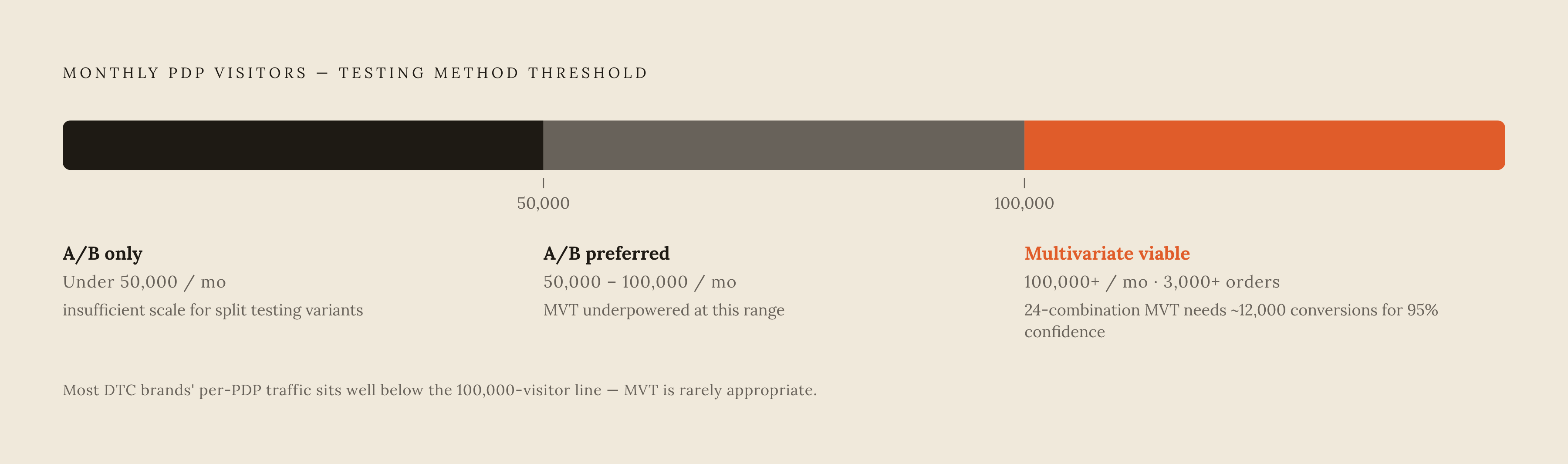
Start with the arithmetic. A page pulling 500 sessions a day, split across eight combinations, works out to roughly 60 sessions per combination per day. At that rate, most multivariate designs never reach a clean conclusion, they just run indefinitely, accumulating data that never crosses the confidence threshold.
Convertibles, reviewing more than 1,000 A/B and MVT tests run on Shopify brands generating over $2M in revenue, puts the line at 50,000 monthly visitors: below that, stick with A/B testing. SplitBase frames the same constraint from the order side, advising against multivariate tests for stores doing fewer than roughly 3,000 orders a month, since anything below that dilutes results past the point of significance.
For DTC product pages specifically, this threshold bites harder than brands expect. Most DTC stores send only a fraction of their total site traffic to any single PDP. That means even a brand with healthy site-wide numbers can have individual product pages sitting well below the volume MVT actually needs.
Ignoring the threshold produces a predictable outcome: tests stall out, get logged as "inconclusive," and the backlog of untested ideas grows while conversion rate stays flat. The threshold is a mathematical requirement grounded in statistical confidence, not a gatekeeping rule invented to slow teams down. It's the math of statistical confidence, and that math doesn't bend just because a team wants the interaction-effect insight badly enough to run the test anyway. The practical implication for DTC product pages specifically holds true.
Research before testing: why the hypothesis determines whether a test is a coin flip or a confident bet
The single biggest difference between brands that get real results from CRO and brands that don't isn't the testing platform they use. It's whether research happened before the test launched. SplitBase makes the point precisely: the exact same test, say, changing which collection gets featured in the homepage hero, can be a coin flip or a 70 to 80% confidence bet, depending entirely on what happened in the two hours before it went live.
Borrowing a "best practice" test from someone else's audit deck doesn't just risk failure. It can actively damage performance, because the underlying hypothesis was built for a different brand's customer base and context, not yours.
SplitBase runs three parallel analyses to build PDP test ideas, including Shopify analytics that cross-reference first-purchase products against long-term customer value. Behavioral data answers what people are clicking that correlates with a sale, and what they're missing entirely, while distinguishing whether a pattern reflects majority behavior or a small, noisy outlier changes how a team prioritizes what to test next. Qualitative research, post-purchase surveys, review mining, direct customer conversation, fills in the why behind a near-miss purchase. And a third layer, friction, catches what's quietly killing conversion without appearing in click data: a broken flow, a slow-loading image carousel, navigation that confuses rather than guides.
Every test functions as both a business decision and a research instrument at once. The output isn't simply a win or a loss, it's a pattern that feeds directly into the next round of research, which makes testing a cycle rather than a straight line from hypothesis to result. Before any test goes live, check whether a higher-converting variant might quietly conflict with the brand's positioning. Optimizing conversion mechanics in a way that undercuts a premium brand identity wins the immediate test and loses the longer argument.
Decision rules for DTC product pages: when to use which method
A/B testing is the right call when the question is narrow and single-factor: one headline against another, one CTA color, one hero image, where a clean yes or no is genuinely all the team needs. It's also the right call when monthly traffic to the specific PDP sits under 50,000 visitors, per Atticus Li's threshold, or when monthly orders sit below roughly 3,000, since MVT at that volume dilutes results past significance. A radical redesign belongs here too. NN/g's guidance is direct on this point: sweeping structural changes are better suited to A/B experiments than to multivariate fine-tuning. Speed matters as well. A/B reaches significance faster because traffic concentrates between two variants instead of spreading across many.
Multivariate testing earns its place under a different set of conditions. Traffic and order volume need to clear the thresholds already discussed, generally 100,000-plus monthly visitors to the specific page in question Atticus Li. The underlying page layout should already be validated through prior A/B testing, since MVT is built for fine-tuning a structure that's already proven, not for exploring which strategic direction to take in the first place. Teams should ask "which combination wins," not "does this one element work," and per Convertibles, that makes MVT the right tool for high-traffic stores squeezing incremental performance out of pages that have already cleared the strategic questions. It also requires a team with the analytical patience to interpret combination-level results rather than a single winner-loser readout.
The practitioner path that ties both methods together is sequential. Start with high-impact A/B tests to validate the big strategic bets and close the largest conversion leaks first. Once a winning layout is confirmed and the page has enough traffic behind it, layer in multivariate testing to optimize the individual elements sitting on top of that winning structure. Convertibles is direct on the sequencing rule: never run both methods on the same page at the same time, though running them on different pages, or one after the other on the same page, works fine. Applied well, MVT gets pointed first at the flows that already carry the most revenue weight, cart recovery, checkout, top-performing PDPs, where even a small combination-level gain moves real money.
The output of that sequence is cumulative rather than redundant. Neither method substitutes for the other, they build on each other.
AI-powered optimization and the testing environment for DTC brands
The shift toward AI-powered optimization marks the biggest methodological change in conversion testing since multivariate testing itself first arrived. Multi-armed bandit algorithms represent the clearest example: instead of holding a fixed traffic split for the full duration of a test, they continuously learn which variation is winning and shift traffic toward it in real time. That's a genuinely different operating model that reallocates traffic in real time as it learns, not merely a faster version of the same one.
For DTC brands, that changes the economics of testing itself. Winning variants get exploited sooner, so revenue isn't sacrificed for the full length of a test the way it is under a fixed A/B split. The tradeoff is that bandit algorithms give up some of the statistical cleanliness a properly run A/B test provides, because they're built to optimize for performance in the moment, not to confirm a hypothesis with methodological rigor.
Layered on top of that shift is something structurally new: product pages are no longer read only by human shoppers. Adobe Analytics measured a 4,700% year-over-year jump in generative-AI traffic to US retail sites between July 2024 and July 2025, meaning product pages are now being read by AI buyer agents, not just human shoppers Atticus Li. And the elements that move a human to convert, emotional copy, imagery, visual hierarchy, aren't the same elements an AI agent evaluates when deciding what to recommend Atticus Li. Agents read structured, consistent, complete data. A page can win every A/B test it's ever run and still lose share to a competitor whose page an AI agent can actually parse and cite. What MAB changes for DTC brands is significant. Pages with complete Product schema are 3.7x more likely to be cited by AI systems, and pages updated within 60 days are 1.9x more likely to appear in AI answers, according to Nudge, June 2026.
Testing and catalog structure as signals for your PDP and AI agents.
Traditional PDP testing, the A/B and multivariate work covered above, answers one specific question: which version of this page gets more human visitors to buy. Agentic commerce adds a second question that same page now has to answer: "Can AI agents accurately understand, represent, and recommend this product?".
That readiness gap isn't a hypothetical concern for some future date. At a panel in Miami, PayPal's Frank Keller cited survey data showing 95% of merchants already see AI agent traffic hitting their sites, yet only 20% have catalogs structured in a way machines can actually read. That's a commercially significant gap sitting between what merchants know is happening and what they've built for.
AI agents rely on structured, consistent, complete product data, schema markup, accurate attributes, and full specifications, while A/B tests optimize visual hierarchy, copy tone, CTA placement, and social proof presentation, elements invisible to a machine reader. Neither track conflicts with the other, but they are not the same track, and treating one as a substitute for the other leaves half the problem unaddressed.
Nor can a brand assume presence on one AI platform carries over to another Atticus Li. Averi's analysis of 680 million AI citations in early 2026 found only 11% overlap in domains cited by both ChatGPT and Perplexity, meaning visibility has to be earned separately across channels rather than assumed. What closes that gap is a single, unified source of trained, structured product data deployed consistently across on-site AI, AI shopping channels, and catalog feeds, the kind of machine-readability testing alone was never built to solve.
The operating principle for DTC teams comes down to running the right test method for the traffic and the question at hand, building the research discipline that makes tests actionable, and, in parallel, treating catalog structure and AI readiness as a separate, non-optional optimization track: it governs whether AI agents can find, understand, and recommend the product at all. What AI agents actually evaluate differs from what A/B tests optimize for.
Sources
- Shopify A/B Testing for 8 and 9 Figure DTC Brands: The Complete Guide
- The A/B Testing Process That Separates 8 and 9-Figure DTC Brands from Everyone Else
- A/B vs Multivariate Testing: Decision Rules by Traffic (2026) – CONVERTIBLES
- Multivariate Testing vs A/B Testing: Key Differences Explained | Growthbook
- A/B vs Multivariate vs Multi-Page Testing | Atticus Li
- Ecommerce A/B Testing: 50+ Test Ideas by Funnel Stage (2026)