How AI Buyer Agents Signal Shopper Intent Before Site Visit
AI agents now decide what you'll see before you shop, so brands must optimize product data upstream.
AI buyer agents learn what shoppers want before they visit a site, so direct-to-consumer brands must compete at the data layer before they can compete at the storefront. The brands that make their product information readable, complete and current can enter the recommendation before the shopper begins browsing. A strong product page still matters, but it cannot win a decision from which the product was already excluded.
How AI buyer agents parse intent before a shopper visits any storefront
A shopping prompt gives an agent constraints before a merchant has a session to analyze. In ChatGPT, Gemini or Perplexity, a shopper can state a budget, required specifications, a delivery window and a brand preference in a single query. The agent decomposes that request into structured intent. It then turns those constraints into API calls that check product catalogs, pricing services, availability feeds and shipping estimators.
That sequence differs from the logic behind most ecommerce personalization. Past purchases and browsing patterns describe behavior a brand has already captured, while a conversational query describes a need the shopper is trying to meet now. Agents can also detect contextual signals outside a product query, including a calendar invite for a move or a message about a new baby. Those signals allow shopping assistance to begin when intent forms, rather than after a shopper enters a discovery funnel.
Why journey compression means brands meet buyers at a different stage than before
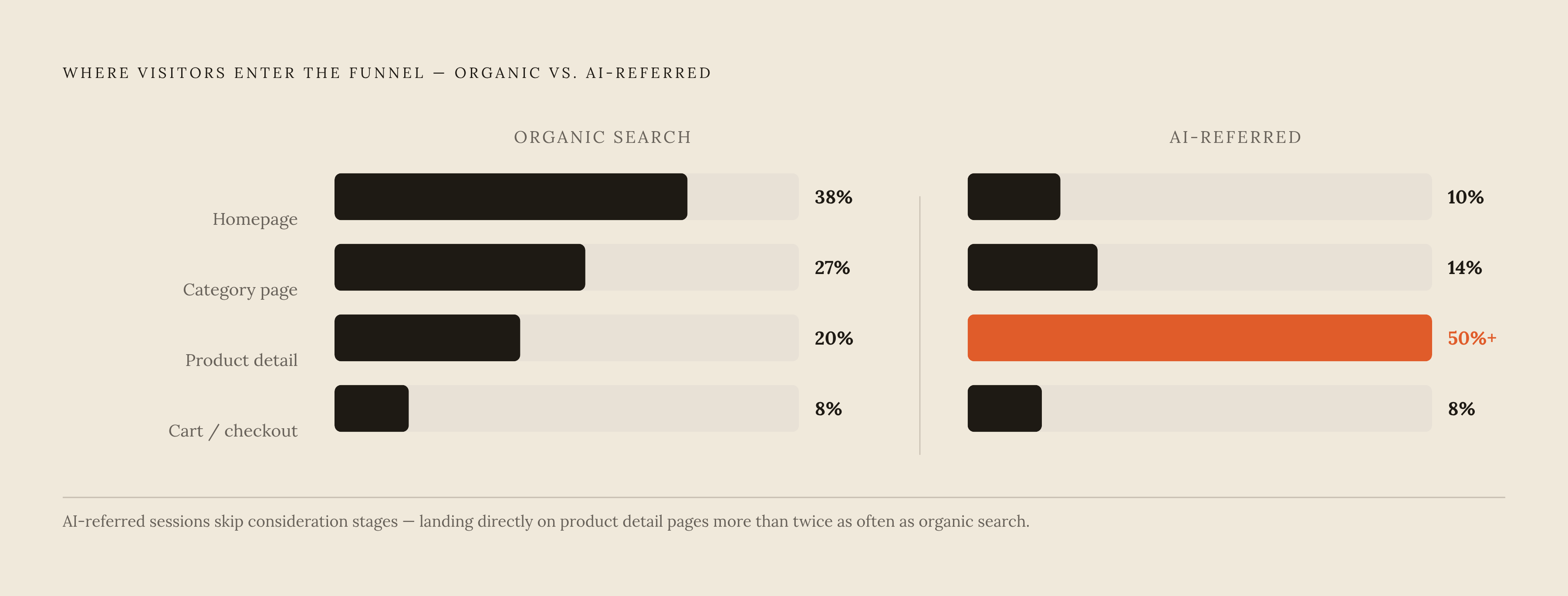
Shopify describes the pattern practitioners call “journey compression,” in which AI-referred shoppers arrive on product detail pages ready to evaluate and buy. More than half of AI-referred sessions start directly on a product detail page, compared to roughly a fifth for organic search. The agent has already narrowed the choice, so the shopper has less reason to work through category pages. Part of the middle of the funnel has moved outside the merchant’s site.
Shopify's Q1 2026 commerce data shows that AI-referred sessions convert at meaningfully higher rates than organic search sessions and carry higher average order values. These outcomes support the argument that the incoming traffic has a different quality of intent. A large Shopify portfolio analysis also found that the overwhelming majority of AI-referred revenue came from first-time customers, far exceeding the new-customer share across the rest of the portfolio.
Higher conversion rates might suggest that brands can concentrate on their product pages and wait for qualified traffic. But that conclusion confuses the destination with the source of persuasion. The upstream recommendation has already done much of the work of selecting a product before the session begins. The page must support the purchase, but it cannot substitute for inclusion in the agent’s decision.
The four AI shopping surfaces and why they read product data differently
The upstream decision takes place across distinct shopping surfaces, namely ChatGPT, Perplexity, Google AI Mode and Amazon Rufus. Each handles product queries in its own way and gets its data from different sources. A product that appears on one may still be missing from another. The distinction matters because readable product data needs a route into the surface where the shopper is asking for help.
ChatGPT accounts for the large majority of AI referral traffic to ecommerce sites and prioritizes content authority and structured data. OpenAI's shopping feature covers a large network of Shopify merchants, including Glossier, SKIMS, Spanx and Vuori. Perplexity sources product data through integrations including with Shopify. Those merchants can use the Shopify infrastructure they already have to sync product data with Perplexity.
Google AI Mode, via UCP, is oriented toward capturing high-intent search queries. Shopify merchants can opt in through Agentic Storefronts in the Shopify admin. Amazon Rufus is a separate shopping surface with its own route. Its presence reinforces the need to distinguish the surfaces without assuming that the same optimization covers all of them.
These differences also separate discovery from transaction. Getting a product into an answer establishes an opportunity to be chosen, while carrying that choice through a purchase is a further requirement. Google's Universal Cart transfer risk illustrates why a recommendation and its handoff cannot be treated as the same problem. A surface may find the right product, but the handoff still needs to keep the exact variant the shopper chose.
What agents actually read — and why most catalogs fail the legibility test
At the product-evaluation stage, an agent needs structured evidence that a SKU matches the shopper’s constraints. It evaluates the quality, completeness and accuracy of the data it can access. Content authority can matter to discovery on a surface such as ChatGPT, but it does not supply a missing product dimension or an unavailable inventory signal. An ad bid cannot fill those gaps either. When the accessible record provides only a partial picture, the agent can deprioritize the SKU in favor of another option.
Most catalogs fail this legibility test because information available to a human shopper is not necessarily available as machine-readable fields. Product details may be in images or PDFs, and attributes may vary from one category to the next. New SKUs may also launch with minimal enrichment because speed-to-publish takes priority over data depth. Brand strength does not resolve that mismatch.
The failures are concrete. Missing dimensions, vague material descriptions and stale pricing leave an agent without enough context to recommend confidently. Without a real-time inventory signal, it cannot confirm availability and moves on. Countdown timers, scarcity warnings and emotional copy cannot fill these gaps, because agents check structured attributes against user intent and do not respond to pressure to buy now. Information that persuades a person cannot stand in for information that establishes fit.
Anthropic developed Model Context Protocol, or MCP, as part of the connective layer through which LLM-based agents can query structured data at scale. With MCP and related emerging standards, protocol readability already affects whether agents can find a product, so brands need to address it now. That changes the commercial role of product data maintenance. For agent-mediated discovery, it belongs at the front line of growth because it helps a product enter the recommendation.
How recommendation frequency — not citation share — predicts whether an agent drives revenue
Once product data can reach an agent, the commercial question is whether the agent directs a shopper toward a purchase. Citation share tracks how often a brand shows up in AI-generated answers. Recommendation frequency measures how often it appears in an actively positive, purchase-directing context. A citation can be a neutral mention, a comparison or a statement with caveats. A recommendation goes further by making the brand or product a buying choice.
That distinction explains why high citation share can coexist with negligible AI-sourced revenue when recommendation frequency is low. The useful measurement therefore concerns the role the brand plays in an answer. This connects performance measurement to the original intent mechanism. An agent that can match a product to the shopper’s constraints has a basis for recommending it.
A shopper may choose a product with ChatGPT's help but buy it through a promotional email three weeks later. Last-click attribution counts that session as email, so the channel report leaves out the help AI gave earlier. The strong first-time-customer skew in AI-referred revenue is consistent with an acquisition influence that a last-touch view does not fully describe. It is not, by itself, a count of every purchase AI helped shape.
To measure this, brands need session-level attribution tied to the conversation ID, post-purchase surveys that ask how customers heard about the brand, a way to track branded search volume, and comparisons of the conversion rate for sessions with and without AI interaction. These measures address different parts of the attribution gap. What brands can measure today gives them a lower bound for how much AI shapes purchases. It is not evidence that AI accounts for every unattributed sale.
What brands can do to be present and legible at the upstream decision
The operational priority is to treat upstream presence as a product data infrastructure problem. Product records need all their attributes, the right pricing and up-to-date availability in forms agents can read. This work addresses the reasons a suitable product can disappear from consideration before a shopper reaches the site. It also gives integrations for each surface the data they need to carry. Access to a shopping surface has limited value when the underlying record cannot answer the shopper’s constraints.
The shopper may be choosing a particular size, color or configuration. A handoff that loses that specificity converts poorly, as the Universal Cart transfer risk illustrates. Maintaining the selected variant through the handoff preserves the match established upstream. Otherwise, the destination asks the shopper to reconstruct a decision the agent has already helped make.
Review velocity also needs to be treated as a threshold issue because agents use review counts and ratings as trust proxies, and products below those thresholds can effectively disappear from recommendation surfaces. Closing that gap is therefore a prerequisite for visibility even with otherwise complete records.
Surface-specific readiness follows from that foundation. Shopify merchants can address Perplexity and ChatGPT visibility through existing Shopify infrastructure, while Google AI Mode opt-in is available through Agentic Storefronts in the Shopify admin. On-site conversational AI then complements this upstream work. TUSHY's deployment of on-site conversational AI resulted in a 190% increase in chat-based purchases and a strong return on investment. The role is distinct, responding to real-time signals such as cart hesitation after the shopper arrives and helping close the gap between interest and purchase.
Why acting before the channel matures is the actual window
Shopify's Q1 2026 growth rate for AI-referred orders looks like the growth seen in mobile and social commerce when those channels were new. Those channels rewarded early movers before becoming expensive and crowded as they matured. Brands can prepare for the opportunity without assuming they will all receive the same return. Building agent-readable infrastructure while the channel is developing gives a brand a basis for competing before AI referral becomes as contested as paid search.
Consumer trust leaves that window open. YouGov's US retail survey finds that a majority of consumers trust AI to compare prices, while far fewer trust it to place orders on their behalf. Discovery can therefore shift toward agents before shoppers are comfortable delegating the transaction itself. Brands do not need to wait for fully delegated purchasing for the upstream decision to matter. The recommendation already determines which products get a chance to receive the visit.
The operator’s choice is consequently about who supplies the evidence for that decision. Complete, current and readable product data allows the brand’s own information to support the agent’s judgment. Act on the data layer now, or be described by someone else’s data later.