
AI-Assisted Conversion Attribution Honesty for DTC Brands
Most DTC brands trust attribution dashboards that systematically overstate ad platform returns.
AI-assisted conversion attribution has become a matter of which dashboard a DTC brand chooses to believe, and most of the popular choices are wrong in the same direction: upward. The dashboards did not fail by accident. They failed because the thing they were built to measure changed shape, and the dashboards kept measuring the old shape.
Why AI-assisted conversion attribution became untrustworthy in DTC commerce
The traditional DTC attribution model assumed a traceable click path: impression, ad click, product page, checkout, with every step measurable and attributable to a channel. That model worked as long as the customer journey stayed inside the systems built to watch it. Two forces broke it at the same time. Apple's ATT changes widened the click-level tracking gap on paid social, and AI agents, ChatGPT, Perplexity, Gemini among them, began influencing and initiating purchase journeys entirely outside the click path attribution tools were designed to follow. Neither force alone would have been catastrophic. Together, they produced a situation where the signal a brand could see shrank at the exact moment a new, large source of demand appeared that no tool was built to see.
The scale of that new source makes the gap concrete. By the first quarter of 2026, AI referral traffic to U.S. retail sites rose roughly 393% year over year, yet most attribution stacks did not tag or track it. A fast-growing acquisition channel generated revenue that showed up in Shopify's order ledger but appeared in no channel's column in the marketing dashboard. That is a structural blind spot, built into tools that were designed for a world where discovery happened through search results and social feeds, not through a conversation with an assistant that reads a product listing, forms a shortlist, and sends a shopper to a merchant site already decided. The click attribution tools register is the redirect, not the discovery event that actually drove the purchase intent, and by the time that click lands, the attribution work has already happened somewhere the dashboard cannot see.
Ad platforms' overstated contribution to the measurement gap
When click-level tracking turns leaky and AI-driven touchpoints go untagged, ad platforms do not leave the resulting vacuum empty. They fill it with self-reported attribution that systematically overstates their own share of revenue. This is not a conspiracy so much as a design incentive: a platform's attribution model counts a conversion as its own if that conversion happened after an impression or click inside its measurement window, regardless of whether some other touchpoint, including an AI referral the platform cannot see, was actually closer to the purchase decision. Every platform is running its own private ledger, and every private ledger is built to claim credit generously.
The scale of the resulting distortion is not subtle. Across a study of more than 200 e-commerce brands in 2025 and 2026, ad platforms collectively claimed more than twice the revenue that actually occurred, overstating true ROAS by more than double the real figure. That gap compounds with cost trends already squeezing DTC margins. Rising Meta blended CPMs mean that as paid social gets more expensive, a brand's actual return on that spend falls, but platform-reported ROAS can hold flat or even climb if the attribution window happens to capture conversions that were really driven by another channel entirely. A brand watching only the platform dashboard sees a healthy number moving in the wrong direction from reality. The post-ATT tracking gap widened this window of ambiguity further, and platforms backfilled the resulting loss of signal with modeled attribution, which inflates their reported contribution precisely where verification is hardest.
Why vendor-defined metrics, "influenced," "assisted," "AI-driven," resist honest interpretation
"AI-influenced" sounds like a causal claim. It usually just means the AI tool was active during a session that converted, which says nothing about whether the AI interaction caused or accelerated the shopper's decision at all.
Consider how this plays out with real, named metrics. Zipchat's first-party report of a chat-to-conversion rate and an average conversion lift measures engaged users against all visitors, not against a controlled holdout group. That comparison tells a brand that engaged shoppers convert at a higher rate than the general visitor population, which is true and also unsurprising, since shoppers who choose to engage with a chat tool are already further along in their decision. It does not isolate the tool's own causal contribution to that outcome. Gorgias's finding that 80% of purchases following an AI Agent product recommendation happened the same day tells a similar story: it describes how fast buyers who interacted with the tool moved to purchase, not whether those same buyers would have bought anyway without the recommendation ever appearing. The same logic extends to channel-level claims. Reporting that AI-referred traffic converts at a high rate, and dlaurieai.com's 2026 analysis places LLM-referred traffic among the top-converting acquisition channels, says nothing about whether a brand's own actions caused that traffic to exist or whether it would have arrived on its own. None of these figures are fabricated. They are simply measuring something narrower than the causal claim they are used to support, and the gap between the two is where inflated confidence creeps into a marketing plan.
What honest measurement requires: incrementality, holdouts, and blended MER
Honest AI-attribution measurement is achievable, and it requires three things most vendor dashboards do not provide by default: a causal test in the form of incrementality or a holdout group, a blended revenue gauge that bypasses platform-level claims entirely, and a confidence interval attached to every channel figure rather than a single confident number. Incrementality testing, showing one group of shoppers an AI feature while withholding it from a matched holdout group, remains the only reliable way to separate causal lift from selection bias, since shoppers who choose to engage with AI tools in the first place tend to already be higher-intent buyers. Without a holdout, a brand is always comparing engaged shoppers to everyone else, which flatters the tool no matter how the tool actually performs.
No single attribution model gets to claim the title of correct. Multiple DTC operators have converged on the conclusion in 2026 that the sound response is not to search for the one true model but to triangulate across several methods at once. Marketing Efficiency Ratio, total revenue divided by total ad spend, calculated straight from a brand's own Shopify or commerce data, bypasses platform self-reporting entirely and reflects what actually happened in the business. It has become the primary truth gauge for serious DTC operators since ATT broke platform-level tracking. Tools like Attribution.ai operationalize this triangulation directly, running Marketing Mix Modeling, incrementality tests, and post-purchase surveys in parallel against Shopify data, and surfacing a confidence interval on each channel's contribution instead of a single claimed number. Post-purchase surveys deserve more credit than they get: a simple "how did you first hear about us?" question captures AI discovery touchpoints, a ChatGPT session, a Perplexity search, a friend's AI recommendation, that no pixel will ever record. One caveat matters for smaller brands: data-driven attribution needs a meaningful volume of conversions to produce reliable results, and below that threshold, clean channel-level attribution is structurally out of reach, making MER the honest primary metric rather than a fallback.
The specific blind spot AI referral traffic creates in most current attribution stacks
Even a brand running rigorous incrementality tests and tracking MER faithfully is probably still undercounting a fast-growing revenue channel, because AI referral traffic arrives without the tags that attribution tools need to classify it correctly. Traffic from chat.openai.com, perplexity.ai, and gemini.google.com lands in most GA4 and Shopify analytics as generic "Referral," or as "Direct" when referrer headers get stripped entirely. GA4's native AI Assistant channel, added in May 2026, now automatically classifies ChatGPT and Gemini traffic, but Perplexity still falls into the generic referral bucket, so the conversion gets recorded while its true source stays invisible. The fix here is not a new tooling investment. Explicit UTM tagging and referral domain groupings for these specific domains recover traffic that was always converting, just misfiled in the direct bucket.
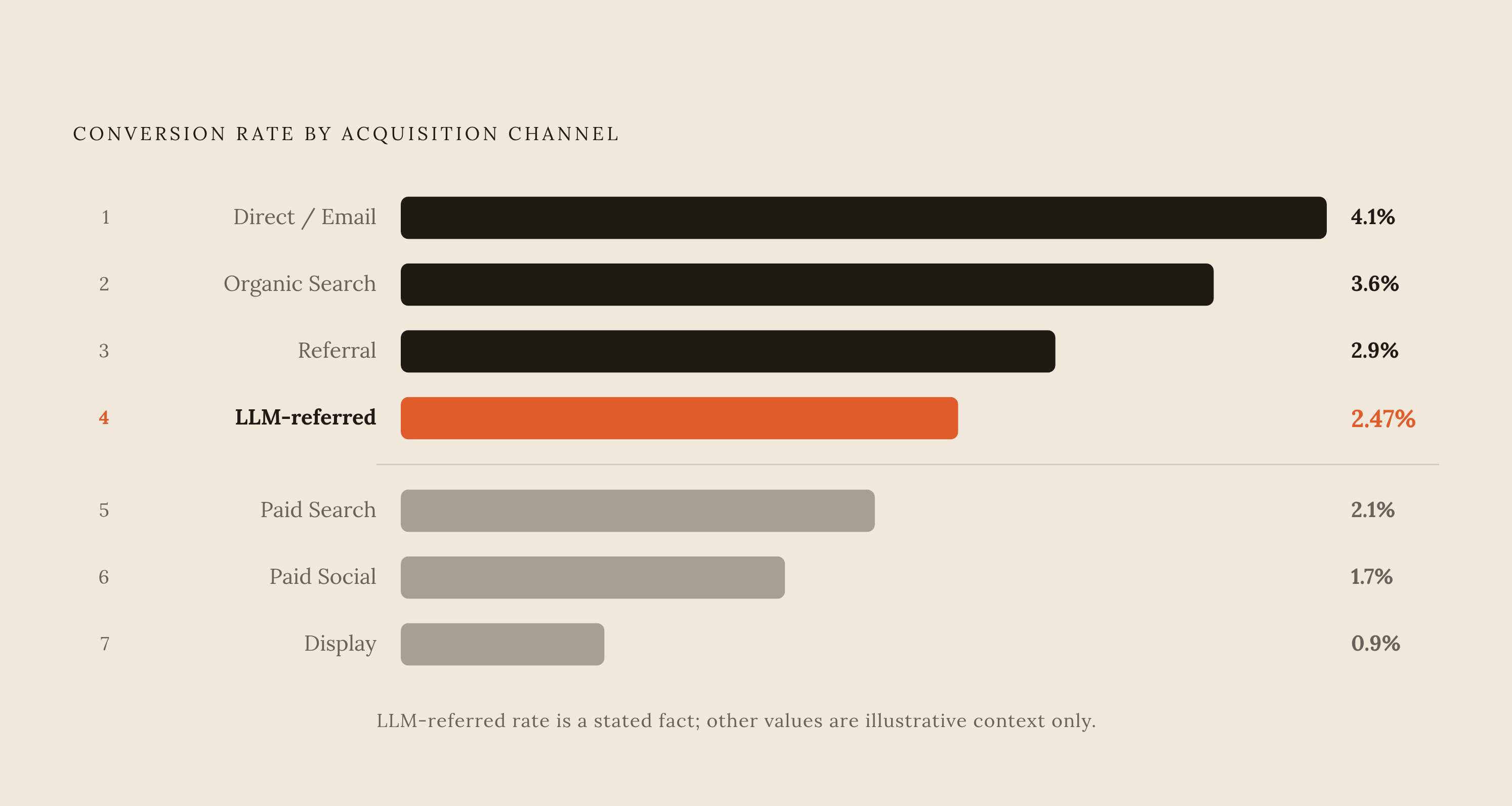
The stakes of getting this right are concrete rather than academic. LLM-referred traffic now converts at a rate of 2.47%, placing it fourth among all acquisition channels and ahead of several paid channels a brand is probably still funding at full price. A brand that cannot see this traffic cannot optimize toward it, and it cannot make an informed internal case for the product data investment needed to capture more of it. The blind spot is a reporting failure with real revenue behind it. It is a channel a brand is already winning in, without knowing it, and without the visibility to double down.
Catalog quality as an attribution variable, not just a discovery variable
Product data quality has traditionally been treated as an SEO and discoverability concern, shaping whether an AI agent recommends a brand's products in the first place. It now determines something further: whether the resulting conversions can be traced back to a specific product or channel. Thin catalogs produce invisible conversions even when the referral tagging behind them is set up correctly. A brand can fix its tagging and still fail to see half its AI-driven revenue, because the underlying product data was never rich enough to generate an attributable signal.
The mechanics reinforce each other. As of May 2026, ChatGPT product feed ads require a connected, eligible product feed, and retailers with thin or inconsistent feeds are locked out of that paid placement channel entirely, not merely pushed down in ranking. Google's Content API for Shopping shut down on August 18, 2026, forcing every programmatic, API-based integration to migrate to the Merchant API, and brands that have not completed that migration lose product visibility on Google AI Mode no matter how well their attribution stack is otherwise built. AI agents choose products based on structured attribute completeness, weighing data quality, intent relevance, price accuracy, and review signals together, so a brand with enriched attributes on half its product line only generates attributable AI revenue on that half, with a systematic blind spot built into the rest. The phrasing of those attributes matters as much as their presence: they need to match natural-language query phrasing rather than category taxonomy, so a listing enriched with "deep navy, fade-resistant, suitable for outdoor use year-round" appears in agent recommendations where a listing that simply says "color: blue" does not, and the entire attribution gap between those two SKUs comes down to a data quality decision made well before any customer ever asked an agent a question. Shopify brands have a native path here: their product catalogs become automatically discoverable in ChatGPT, and storefront features active by default and manageable through the admin panel enable in-chat checkout on channels like Copilot and Google AI Mode, while ChatGPT itself redirects buyers back to the brand's own store checkout. But automatic discoverability paired with thin product data just produces AI referrals that convert poorly and generate attribution noise instead of signal. Product data enrichment and attribution accuracy are the same investment, made once, showing up twice: first in whether an agent recommends the product, and second in whether the brand can ever prove it did.
Evaluating an AI tool's attribution claims before acting on them
Before a brand treats any AI tool's reported conversion lift as grounds for a budget decision or a strategy shift, it should be able to answer four specific questions about how that number was actually produced. The comparison group matters first: a metric that compares converting chat users to the average of all visitors is conflating the tool's own performance with the simple fact that engaged shoppers self-select toward higher intent, and only a genuine holdout test can separate the two. Where that lift appears in a brand's own numbers matters just as much: if a brand's own blended MER did not move when the tool was introduced, then whatever lift the vendor dashboard is reporting has not reached the business's bottom line, however it is being presented. The vendor's own definitions deserve direct scrutiny too: a brand should ask what triggers "influenced" or "assisted" status, whether it is mere session presence, a click, a message sent, or a recommendation actually accepted, and what share of converting sessions met that threshold without any meaningful interaction. Finally, a brand needs to know whether its own analytics can even see AI referral traffic from ChatGPT, Perplexity, and Gemini as a distinct channel, or whether that traffic is still pooled into an undifferentiated "direct" bucket. A brand that cannot see the channel cannot evaluate any claim made about it, honestly or otherwise.
A measurement approach trained on a brand's own product data, policies, reviews, and voice, and applied consistently across on-site and AI shopping surfaces alike, is positioned to answer these questions honestly, because its measurement is grounded in the brand's own data rather than shaped by a vendor's model. The right benchmark for any AI tool a brand considers adopting is its performance among engaged shoppers measured against that brand's own baseline, not against an industry average or a vendor-supplied comparison, both of which carry the same inflation risks described throughout this analysis. None of this argues for caution over speed. It argues that speed and honest measurement are not in conflict: the brands that move first on AI readiness while insisting on holdouts, blended MER, and clean referral tagging will build a real advantage over both the brands that wait and the brands that move fast while chasing numbers built to flatter them.