Last-Click Attribution Blind Spots in DTC Conversion Reporting
Last-click attribution systematically misallocates DTC budgets across channels.
Last-click attribution gives all of the credit for a sale to the final touchpoint a customer clicked before buying, and it gives none to everything that came before it. That rule once produced a workable approximation of reality. It now produces a systematically distorted picture of which channels drive a DTC brand's growth, and understanding exactly where that distortion lives is the precondition for fixing a budget built on it.
Last-click attribution was built for a world that no longer exists
The logic of last-click is simple enough to explain in a sentence: find the final touchpoint before purchase, assign it all the revenue, and treat everything upstream as having contributed nothing. That logic held up reasonably well when a customer discovered a product and completed a purchase in one or two steps through a channel that could actually be tracked end to end. A shopper clicked an ad, landed on a product page, and bought. The final click and the originating click were often the same click, so crediting the last one didn't do much violence to the truth.
That kind of journey is no longer the norm. A modern DTC purchase path routinely strings together discovery on social media, a branded search days later, a site visit, a retargeting ad, an email open, and a final return visit, spread across multiple devices and sometimes a week or more of elapsed time. The model built to credit a single step has not changed to accommodate a journey that now runs through five or six. That mismatch between a static rule and an increasingly fragmented path to purchase produces the structural flaw that causes everything that follows. Two forces now active in the market have taken that flaw from a tolerable approximation error to something that actively misleads the people deciding where next quarter's budget goes.
Two forces that have made last-click's distortions severe enough to actively mislead budget decisions
The first force is a steady collapse in the signal last-click depends on to work. Safari and Firefox deprecated third-party cookies by default years before Chrome made its own cookie decisions, so roughly half the web has already been living in an effectively cookieless state for some time. A mobile platform's tracking-permission prompt added a second, permanent wound: the opt-out rate it produced caused irreversible signal loss on that platform, and that damage to pixel-based measurement hasn't stopped compounding. Pixel-only tracking setups keep eroding on their own terms, too, as ad blockers, browser-level tracking restrictions, and consent rejections each subtract a slice of what would otherwise get recorded. Google shut down most of its Privacy Sandbox components in October 2025, retiring APIs including Attribution Reporting, Topics, and Protected Audience across Chrome and Android, and no official replacement exists for the attribution function they were meant to serve. None of this arrives as a single dramatic break. It arrives as drift: platform-reported numbers slowly pull away from backend revenue with no alarm attached to the moment it happens, so the gap is often large by the time anyone notices it.
The second force is a category of traffic that last-click was never built to see. AI shopping assistants, including ChatGPT, Gemini, and Perplexity, are now sending real volume to DTC storefronts, but mobile apps and certain in-app browsers on these platforms strip the referrer data that would otherwise identify where a visit came from. That traffic lands in standard GA4 setups misclassified as direct, so any attribution model built around clicks can't see most of it. The undercount isn't a rounding error: it's a structural break in the referrer chain at the platform level, and it understates a growing channel by construction, not by poor measurement hygiene. Meta compounded the confusion from a different angle, deprecating its 7-day view attribution window in January 2026, on top of the 28-day view and 28-day click windows it had already removed back in 2021. What's left by default is a 7-day click and 1-day view window, and historical benchmarks broke overnight when the change hit. It was a definitional shift in what counts as a conversion, not an improvement in how well conversions get measured. These two forces don't offset each other. Signal loss shrinks what last-click can see, AI-referred traffic adds a growing category it was never built to see, and together they stack into the specific blind spots that follow.
The bottom-funnel over-credit problem: why branded search and retargeting look better than they are
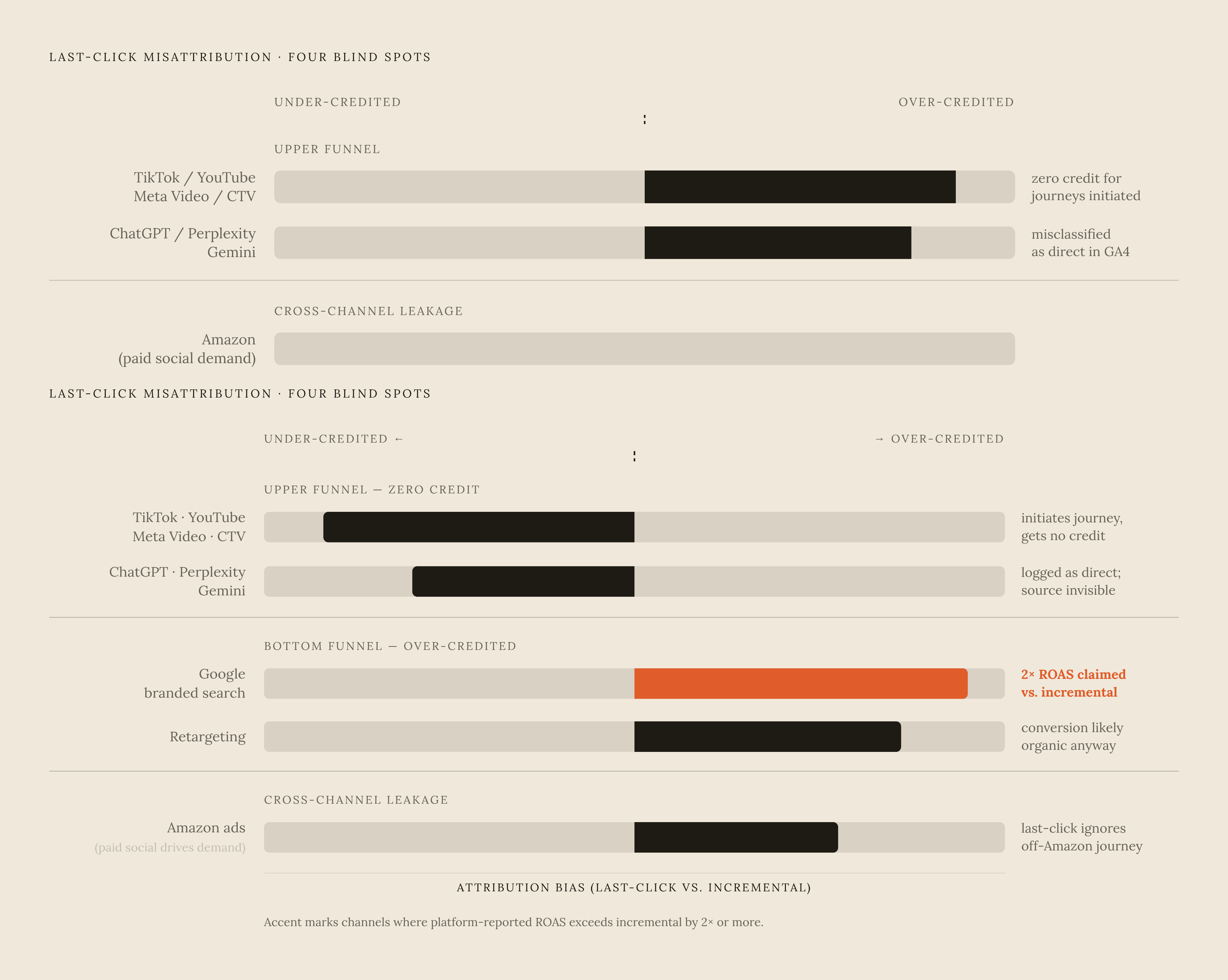
Last-click's errors aren't random noise scattered evenly across channels. The model reliably funnels credit toward channels that intercept demand someone else already created, and it doesn't credit the channels that created it. Branded search is the clearest case: a shopper who searches a brand's own name has typically already decided to buy from that brand, so the ad or organic listing that catches the click harvests intent that already exists. Under last-click, that branded search term reads as a high-performing channel, and it's often the highest-performing one in the account. The number it can't answer is whether that same shopper would have found their way to checkout without the ad being there.
Incrementality testing exists to answer exactly that question, and geo-holdout experiments, which run a campaign in some regions while holding it back in others, are the method that isolates what a channel actually causes from what it merely sits beside. Common Thread Collective's database of real geo-holdout tests puts the median incremental ROAS of Google branded search well below breakeven, so most of the revenue credited to that spend would have arrived with or without it. Retargeting runs on the same underlying mechanic: it reaches people who already visited the site and were already likely to come back, and last-click credits it with manufacturing conversions that were substantially already in motion. Across a large dataset of ecommerce brands studied in 2025 and 2026, platforms overstated true ROAS by more than double on average, and retargeting-heavy programs sat among the most over-attributed in that dataset.
None of this means branded search deserves a blanket cut. A low incremental ROAS doesn't automatically mean the spend is wasted: defending a brand name from competitor bids carries strategic value that an incrementality number alone won't capture, since losing that auction can cost market position even when the direct sales lift is small. The sound response is to test each case rather than eliminate the channel on sight, and incrementality testing is the tool that makes that distinction possible. It also points to the exact opposite failure sitting on the other side of the funnel.
How impression-led channels get defunded
Last-click only records clicks, so channels that build demand mainly through impressions, including TikTok, YouTube, Meta video, and connected TV, get under-credited by design. A shopper who sees a TikTok creative, remembers the brand a few days later, and converts through a Google search or an email link produces a conversion that last-click assigns entirely to the search or the email. The TikTok spend that started the entire sequence gets nothing, even though it's the reason the search happened. Fospha's analysis of TikTok's role in DTC purchase paths documents this pattern directly: the platform routinely initiates journeys that close somewhere else, and last-click's accounting shows a channel that looks like it isn't working when it's actually the one doing the work furthest upstream.
The organizational consequence follows a predictable sequence. A brand looks at last-click reporting, sees TikTok underperforming relative to branded search and retargeting, and redirects budget away from it. New customer acquisition slows because the channel that was introducing the brand to new shoppers has been cut. Bottom-funnel channels still harvest demand from the prospecting spend that already happened, so they keep reporting strong numbers for a while and nothing in the dashboard signals a problem yet. Eventually that upstream demand runs dry, the pipeline thins, and growth stalls in a way that looks sudden but was set in motion months earlier. A team compensated against last-click ROAS can hit every number it's judged on even as the brand quietly stops acquiring new customers, because the model raises no internal warning until the depletion has already happened.
The Amazon blind spot: when the final sale happens off the brand's own storefront
A third blind spot sits outside the brand's own website. For DTC brands that also sell on Amazon, the single largest source of misallocated budget may be sales that last-click can't see at all, because the transaction closes on a different platform than the one that created the demand for it. A shopper sees a Meta or TikTok ad, develops interest in the product, and completes the purchase on Amazon. Last-click attributes that sale to Amazon, or to whichever Amazon ad or branded search term happened to be the final click inside Amazon's own ecosystem. The paid social spend that put the product in front of the shopper in the first place receives nothing, and from the standpoint of last-click reporting, that ad simply didn't work.
For brands operating on both channels, Amazon tends to be the largest blind spot in the entire measurement stack, because last-click has no mechanism for connecting a DTC ad impression to a conversion that happens on a separate platform's checkout. As a result, the brand systematically under-invests in the paid social activity seeding its Amazon demand, while Amazon's own attribution tools take credit for conversions they didn't originate. The mechanism matches the TikTok pattern: an impression-led touchpoint creates demand that converts somewhere else. It's compounded here by the fact that the somewhere else is a platform running its own attribution system with no incentive to credit a touchpoint it didn't own. Taken together with bottom-funnel over-crediting and the upper-funnel defunding cycle, the Amazon gap completes a three-part map of where last-click goes dark, and seeing all three clearly is what makes it possible to choose a corrective measurement approach that actually addresses them.
AI-referred traffic is now a fourth blind spot that last-click cannot track
A fourth blind spot has opened alongside the first three, and it's growing faster than any of them. AI shopping assistants are already sending high-converting traffic into DTC storefronts, and last-click has no way to trace where that traffic originated. Shoppers who use ChatGPT, Perplexity, Gemini, or similar tools to research a purchase before visiting a brand's site generate visits that standard analytics setups classify as direct, because the referrer data that would normally identify the AI platform as the source gets stripped before it ever reaches GA4. A large share of these sessions arrive with no referrer at all, so last-click ends up crediting the conversion to whatever the shopper happened to click once they landed on-site, whether that's an organic search, an email link, or a retargeting ad, rather than to the AI-mediated research session that actually produced the buying intent.
This isn't a problem for next year. Shopify reported that AI-driven traffic to its merchant stores grew dramatically year over year in the first quarter of 2026, and orders originating from that traffic grew even faster than the traffic itself did. A shopper arriving from an AI assistant has typically already asked a specific question, received a specific answer, and followed a specific recommendation, so the intent behind the visit is pre-filtered in a way that most channels never achieve, making the conversion quality behind those numbers high. High conversion value sits inside a channel last-click can't see, so the misattribution here isn't just common, it's expensive. Under last-click, this traffic gets folded into direct or branded search, so those channels' apparent performance inflates further, and the AI-mediated moment that actually shaped the purchase decision disappears from the report. Brands that invest in structuring their product data so it's readable by AI agents, and surfaceable through tools like ChatGPT, Google, and Perplexity, put themselves in position to capture this traffic now and eventually measure it as its own channel instead of losing it permanently to the direct bucket.
What an honest measurement stack looks like
No single attribution model can close all four blind spots on its own. The approach practitioners are converging on instead is a three-layer stack in which each layer answers a different question, and at any meaningful level of spend, none of the three layers is optional.
The first layer is server-side tracking, and it functions as the data foundation for everything else. Pixel-only setups keep degrading under ad blockers, browser privacy restrictions, and consent rejections, but server-side event routing keeps the underlying signal durable, because it sends conversion data from the server instead of relying on what survives inside the browser. This layer doesn't change which model gets used to assign credit. It makes sure the conversion data feeding whatever model is running is as complete as it can be before any attribution logic touches it.
The second layer is incrementality testing, and it functions as the truth check against everything the first layer feeds into. Incrementality testing measures the conversions a given spend actually caused against what a platform attributes to itself, and the distance between those two figures is the over-attribution a brand has been budgeting against. Geo-holdout tests run a campaign in some regions while withholding it in others, and they remain the gold standard for channels with enough volume to split geographically; they're also the method that produced the branded search findings cited earlier in this piece.
Last-click still has a legitimate role inside this stack. It's fast, it's operationally legible to a team that needs a daily pacing number, and it works fine for tactical, same-day decisions about which creative or audience to adjust. Incrementality testing is the quarterly or periodic correction that checks whether last-click has been telling the truth all along. Last-click was built to report that something happened and when it happened, not to explain why a campaign worked or whether it caused the result credited to it. That's a reasonable job for daily pacing and an unreliable basis for an annual budget.