Engaged Shopper Cohorts as a CRO Measurement Unit
Engaged shopper cohorts replace blended conversion rates with intent-based measurement.
Sitewide conversion rate, the metric most Shopify brands still lead with in board decks, cannot actually tell an operator what is wrong with their store. The number blends fundamentally unlike visitors into a single rate, and that blend produces decisions that are frequently backwards. This piece lays out what an engaged shopper cohort is, why it beats session rate as a measurement frame, and what building one requires as AI reshapes how purchases happen at all.
Why sitewide conversion rate is a structurally dishonest denominator
The math behind sitewide conversion rate looks clean: conversions divided by sessions. The problem sits in the denominator. A "session" is not a coherent population. It might be a loyal customer on her fifth purchase, a cold click from a paid social ad, a bot crawling product pages, or someone who landed on a blog post and left within seconds. Averaging a purchase-ready repeat buyer with a visitor who never intended to browse products produces a rate that describes nobody in particular.
Polar Analytics' 2026 Shopify CRO guide calls this the "vanity version" of conversion rate: it blends everything and hides every useful signal, and the numbers that actually move decisions are segmented by channel, landing page, and new versus returning visitor. That segmentation matters because the gap between visitor types is not small. Contentsquare's 2026 data, drawn from billions of sessions across thousands of sites, shows returning visitors convert at roughly 70% higher rates than new visitors, a differential a blended rate erases entirely.
The distortion compounds when traffic mix shifts. Polar Analytics notes that a paid acquisition push flooding the site with cold visitors can drag the blended rate down with nothing on the site itself having changed. Operators read that dip as a performance problem and start second-guessing product pages or pricing, when the real explanation is upstream in media buying. Blend Commerce's 2026 Shopify benchmark review makes a related diagnostic point: a store with a healthy add-to-cart rate but weak checkout completion has an entirely different problem from a store where visitors barely engage with product pages at all, and sitewide rate cannot tell you which one you have. One number, two diagnoses, no way to tell which applies.
How the funnel leaks in aggregate
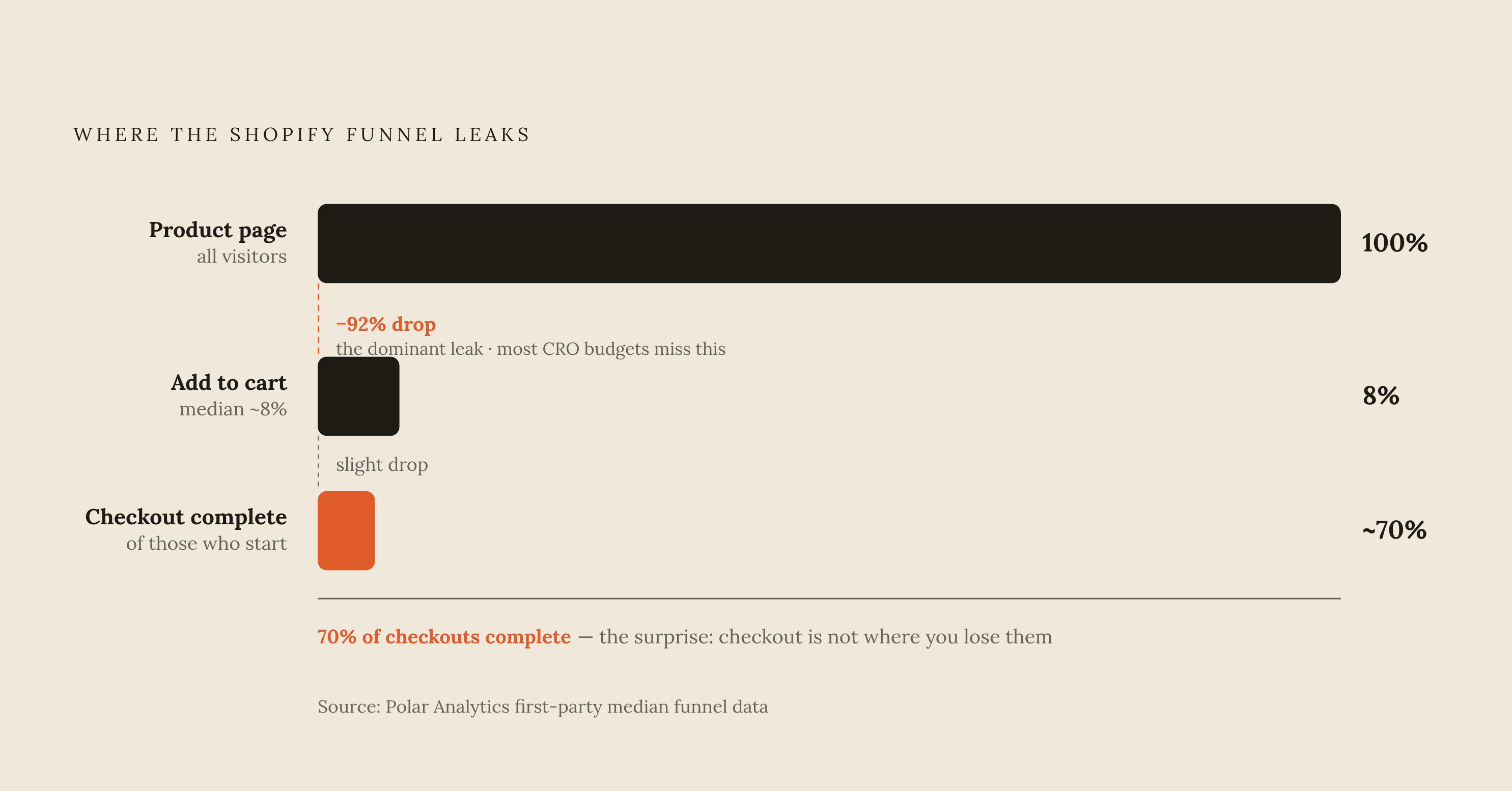
The biggest revenue leak in most Shopify stores happens at the product page, not at checkout, and a sitewide rate cannot reveal this because it averages across every funnel stage at once. That single fact reorders where CRO effort should go for a large share of DTC brands.
Polar Analytics' first-party median funnel data shows the steepest drop happens before add-to-cart: most visitors never add anything to their cart in the first place. Once a shopper does start checkout, however, the majority finish it. That pattern flips the conventional wisdom. Checkout is where most CRO budgets go (cart abandonment emails, one-click payment buttons, trust badges near the buy button) yet the data says the leak is earlier, at the point where a visitor decides whether a product is worth adding to a cart at all.
Blend Commerce's 2026 benchmark analysis draws the same line: shoppers who add products but rarely complete checkout point to checkout friction, and shoppers who rarely add products in the first place point to problems with product pages, the offer, and traffic quality. Those are two completely different interventions, and a single conversion rate conflates them into one undifferentiated number. A brand cannot tell which fix it needs by looking at the sitewide rate. It has to look at the funnel stage by stage.
That confusion has a measurable cost in wasted testing effort. Musemind's CRO statistics report finds that the median experimentation program across more than a thousand companies produces only a handful of statistically significant winners per year, each delivering a small revenue lift. That is not evidence that testing doesn't work. That is evidence that most CRO effort is misdirected rather than that testing does not work, because the aggregate rate never told anyone where the real leak was. Teams test what shows up in the dashboard, not what the segmented funnel actually indicates is broken. Fix the measurement and the testing roadmap changes on its own.
Defining the engaged shopper cohort
An engaged shopper cohort is a bounded group of visitors defined by active interaction with a product, a discovery flow, or an on-site AI assistant, a population whose behavior differs meaningfully from passive browsers and therefore functions as a coherent denominator for conversion measurement. The distinction from a session is not subtle. A session counts anyone who loaded a page. A cohort counts only people who did something that signals they were actually shopping.
The qualifying action is intentional engagement: clicking into a product page, using search or a filter, asking an on-site AI assistant a question, or moving through a guided discovery flow. A visitor who lands and bounces, or scrolls a blog post and leaves, does not qualify. That threshold is deliberately behavioral rather than demographic. It doesn't care who the visitor is; it cares what the visitor did.
Personalization segments like purchase frequency, AOV tier, or category affinity are a separate category from the engaged cohort. Those are targeting constructs, built to decide who sees what offer. An engaged cohort is a measurement construct: a denominator for calculating a conversion rate that reflects actual intent. Confusing the two leads brands to build cohorts for marketing purposes and then try to repurpose them for measurement, which produces the same distortion sitewide rate already causes, just at smaller scale.
The Build Grow Scale 2026 analysis cites research showing personalization built on behavioral cohorts, things like purchase frequency, AOV tier, category affinity, and session depth, produced lifts many times larger than generic "recommended products" personalization based on browsing history alone. The precision comes from cohort definition, not from the personalization tactic layered on top of it.
The sharpest version of the engaged cohort comes from AI assistant interaction specifically. Shoppers who engage an on-site AI assistant sit on one side of a natural line between high-intent and passive traffic. Ecommerce shopper behavior research from 2025 found these two groups convert at roughly a four-times rate difference, and the engaged group reaches checkout measurably faster. Returning shoppers who use the AI assistant also spend more per order than returning shoppers who skip it, which means the cohort captures order-value lift alongside conversion probability, not conversion probability alone.
A cohort can be defined at several levels of specificity: any visitor with a product page view plus one active interaction; visitors who used search, filter, or a discovery flow; visitors who engaged an on-site AI assistant; and returning visitors within any of those groups. Each level produces a cleaner signal than the blended session rate, and each maps to events most analytics stacks already log.
Why the engaged cohort beats session rate
Conversion rate measured inside an engaged shopper cohort functions as a leading indicator of revenue. Conversion rate measured across all sessions functions as a lagging artifact of traffic mix and channel spend. That distinction is the argumentative center of this entire framework.
When the denominator is every session, a change in the rate can mean three different things at once: conversion behavior actually improved, traffic composition shifted toward higher-intent visitors, or a paid campaign flooded the site with low-intent clicks. The number itself carries no way to tell those three apart. When the denominator narrows to the engaged cohort, a rate change carries exactly one meaning: the share of genuinely interested visitors who completed a purchase moved. That single, unambiguous meaning is what makes the cohort rate actionable in a way the session rate never can be.
Contentsquare's 2026 finding that AI-referred traffic reversed direction over 14 months, moving from significantly underperforming non-AI traffic to significantly outperforming it, only becomes interpretable at the cohort level. At the aggregate level, AI-referred sessions are just one more session type folded into the average, invisible as a distinct trend. Adobe Analytics data tracking the same shift shows traffic source quality changing faster than aggregate benchmarks can register it. A brand optimizing its sitewide rate in Q4 2024 would have read AI-referred sessions as underperformers and deprioritized them. A brand optimizing its engaged-cohort rate instead would have caught the reversal in progress and leaned into that channel months earlier.
Polar Analytics makes a broader point here that applies directly: a KPI is a definition, not a number. Two stores reporting an identical conversion rate can be counting entirely different populations. The same logic governs the cohort. Defining the cohort with precision is the act of measurement itself.
The most obvious objection deserves a direct answer rather than a dodge. Isn't the engaged cohort self-selecting? Visitors who interact more are already likelier to buy, so doesn't measuring their conversion rate just confirm what was already known? Yes, and that's the entire point of building the cohort in the first place. The cohort is higher-intent by definition. The useful question for CRO is what share of that already-interested group converts, why the rest do not, and which interventions move that share. A broken product page, a missing size chart, or an AI assistant that can't answer a basic material question blocks even a visitor who arrived ready to buy. The cohort rate surfaces that failure with precision the session rate structurally cannot, because the session rate can't isolate the high-intent group in the first place to measure how it's failing.
How agentic commerce is breaking the session model entirely
The session model is starting to miss purchase events altogether. When an AI agent executes a purchase on a buyer's behalf without a human ever opening a browsing session, session-based conversion rate doesn't just undercount performance, it fails to register that the purchase happened at all. That failure mode makes engaged-cohort logic the only measurement frame that still works for a growing share of commerce.
Agentic commerce describes a purchase model where autonomous AI agents act as proxies for buyers, carrying out discovery, evaluation, authorization, payment, and fulfillment from a stated goal rather than a sequence of clicks. The human never visits the site in any traditional sense. This is not a hypothetical future state. OpenAI data shows ChatGPT processing tens of millions of shopping queries daily, and Salesforce reported that during Cyber Week 2025, a significant share of all global orders were influenced by AI agents or shopping assistants. Adobe Analytics measured a very large year-over-year jump in generative-AI traffic to US retail sites between July 2024 and July 2025, growth at a scale that makes this a live operational condition for DTC brands right now.
The infrastructure to support agent-mediated purchasing is already shipping. Google launched the Universal Commerce Protocol at NRF in January 2026, giving AI agents a single open standard for interacting with merchant catalogs and completing purchases. Forrester projects that by the end of 2026, at least one in five B2B sellers will be compelled to respond to AI-powered buyer agents with dynamically delivered counteroffers issued through seller-controlled agents of their own. The conversion event itself is shifting from a human clicking "buy" to two agents negotiating a transaction between them. Shopify's Spring '26 platform update made AI commerce the default posture for DTC merchants, adding direct checkout inside AI surfaces, a Shopify Catalog product, UCP and MCP rails, visual search, a Knowledge Base, Product Disclosures, and a native Agentic section built into the admin. Shopify reported that orders originating from AI-powered searches grew substantially year over year through 2025.
None of this means the browser session is finished. Nudge's research found that a large majority of consumers still prefer clicking through to a website rather than completing a purchase inside an AI interface directly. The session isn't obsolete, but it is becoming an incomplete picture of how commerce happens, and that gap will only widen as agentic infrastructure matures. Research presented at the ACM Web Conference in 2026 documented systematic biases in how agents choose among products, so a brand cannot assume an AI agent will recommend its catalog fairly or consistently even after enriching it. Session-rate measurement has no way to even detect that kind of risk, let alone correct for it.
What catalog quality has to do with cohort size
The size of a brand's engaged shopper cohort changes with catalog quality. It's a direct function of how well that brand's catalog is structured. A brand with poorly organized product data ends up with a smaller cohort to measure, because AI shopping surfaces, both the assistant on its own site and external tools like ChatGPT or Gemini, fail to surface the right products against the right queries. Fewer genuinely interested visitors arrive in the first place.
The scale of the gap is larger than most merchandising teams assume. A Data World study cited in Nudge's 2026 research found that properly structured content sees a substantially higher AI selection rate than unmarked content, yet the majority of ecommerce sites currently implement schema incorrectly. Most brands are shrinking their own engaged cohort without realizing it, simply through sloppy product feed hygiene. Nudge's research adds a related warning: more than half of brands that rank well on Google are not cited by AI systems at all, a structural gap that means SEO performance is no longer a reliable proxy for AI-channel visibility.
A category of infrastructure has started forming specifically around this problem. Getcatalog.ai, a San Francisco startup founded in 2025 that raised a $3M pre-seed round led by Acrew Capital (announced March 2026), ingests a brand's catalog, enriches it with AI-readable attributes, and distributes it to ChatGPT, Gemini, Claude, Perplexity, Amazon Rufus, and Walmart Sparky. Productsup launched its AI Enrich module in May 2026, generating product highlights, Q&A pairs, and use-case tags meant to help catalogs surface inside ChatGPT, Gemini, and Perplexity. Salsify launched SalsifyIQ that same month, with an AEO Accelerator inside its Intelligence Suite generating Q&A and use-case copy aimed at influencing how LLMs and answer engines describe a brand's products.
The CRO implication is direct rather than incidental. Catalog enrichment is not a marketing task sitting upstream of conversion work. It expands the denominator of the engaged cohort itself, by increasing the number of visitors who arrive already holding genuine product intent. Brands with enriched, structured product data get cited and selected by AI shopping surfaces. Brands without it get described by whatever an outside model manages to piece together on its own, and the visitor who eventually clicks through, if one clicks through at all, arrives less informed and less likely to convert.
How on-site AI interaction generates new data
An on-site AI assistant does more than answer product questions or nudge a hesitant shopper toward checkout. It generates the raw behavioral signal that makes the engaged cohort measurable in the first place. Every question a shopper asks it, every comparison it's asked to run between two products, every clarifying detail it surfaces about sizing or materials or compatibility, becomes a logged interaction that marks that visitor as belonging to the high-intent group rather than the passive one.
That is a category of data most Shopify stores simply did not have access to before conversational interfaces became common on product pages. A page view says a visitor looked at something. A completed AI conversation says a visitor was actively trying to decide whether to buy it, what questions gave that person pause, and where in the product story the assistant either closed the gap or failed to. Layered against the funnel data described earlier, showing that the steepest drop happens before add-to-cart, that interaction log becomes the diagnostic tool the sitewide rate could never provide: a record of exactly which questions high-intent shoppers ask right before they either convert or leave.
Sources
- CRO Guide for Shopify: How to Turn More Visitors Into Buyers in 2026
- CRO Statistics Report 2026: 105 Key Statistics Backed by Evidence
- eCommerce Conversion Rate Benchmarks 2026 | Shopify CRO
- CRO Trends 2026 Recap: What Worked & What's Next | Build Grow Scale
- What Is Agentic Commerce? The 2026 Guide | Support - Eco