Machine-Readable Product Pages for AI Shopping Assistants
AI shopping agents need structured product data to find and recommend your items at all.
ChatGPT and Amazon's Rufus don't rank products by brand prestige or persuasive copy. They parse structured data and match it against what a buyer actually asked for. A product page that can't be parsed simply doesn't exist to the agent, no matter how sharp the photography or how polished the copy reads to a person.
OpenAI reported that ChatGPT processes 50 million shopping queries a day, and Amazon reported that Rufus serves 300 million users; this is already the operating environment. Adobe Analytics measured a 4,700% year-over-year jump in generative-AI traffic to US retail sites between July 2024 and July 2025. Most retail teams haven't built a single process around any of it yet.
Paz.ai described the agentic shopping flow in 2026 as a multi-stage sequence moving from intent capture through discovery, evaluation, and transaction execution. A product page gets evaluated at stage two, before any human sees a recommendation. Agents query merchant catalogs through structured data feeds and compare attributes directly: price, stock status, shipping speed, review counts, relevance to the stated goal. Page design and brand storytelling play no role in that sequence. A page built to persuade a person but never built to be read by a machine may never make it into the candidate set the agent considers, regardless of where it sits on a Google results page.
nshift, writing in February 2026, calls this "agent legibility." An offer has to be comparable by a machine, not just attractive to a person, and those are two different jobs. Most product pages were only ever built to do the second one.
Traditional SEO rank versus AI citation
Audit after audit finds the same disconnect: plenty of brands that rank well on Google get skipped entirely by AI systems. Domain authority, backlinks, years of SEO spend, none of it feeds into how an AI agent picks a product. Most marketing teams still get this backwards, treating AI citation like a new SEO channel instead of a different game with different rules. That mistake costs real money, and it's the single most common error in how brands approach this problem right now.
ChatGPT's selection logic runs on different fuel. Authoritative list mentions are the biggest single factor, followed by awards and review volume. Structured data quality plays a central role in whether a brand gets cited, operating on different logic than search rankings do.
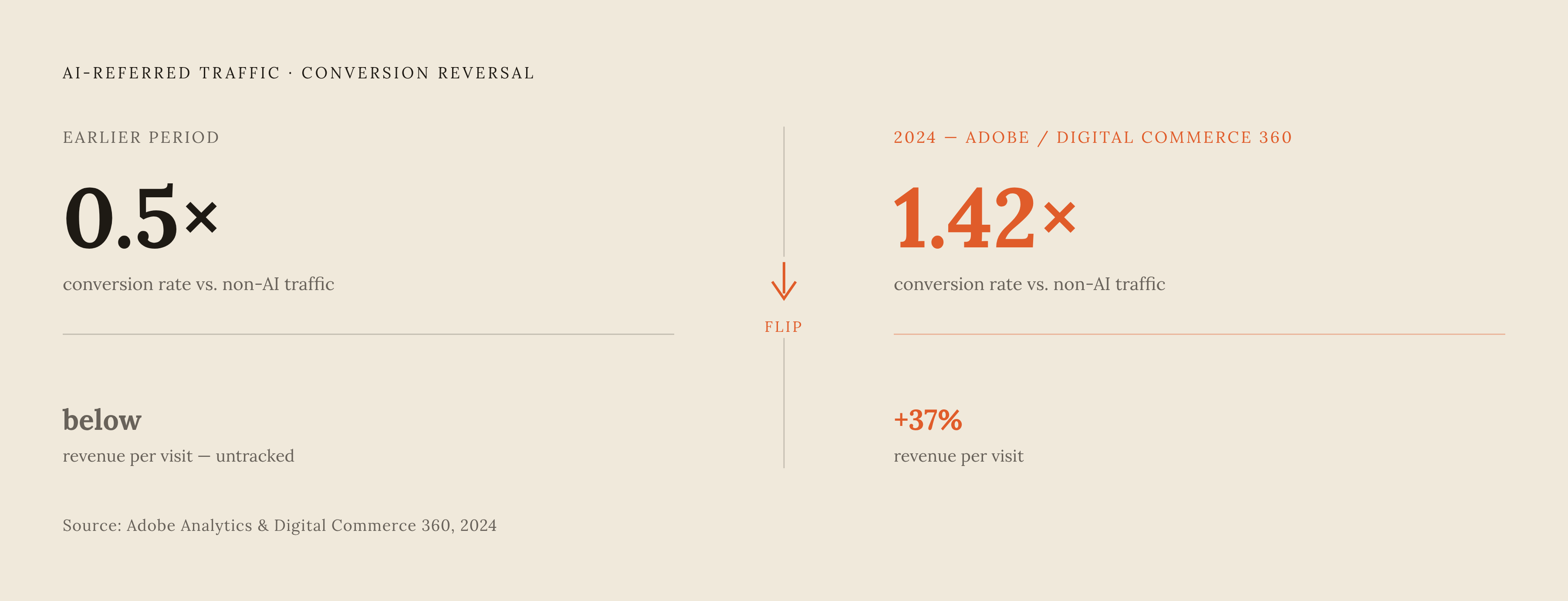
Adobe and Digital Commerce 360 reported that AI-driven traffic converted 42% more often than non-AI traffic, with revenue per visit running 37% higher. A year earlier, the same Adobe data had AI-referred visitors converting at roughly half the rate of regular traffic. That reversal means agentic referrals moved from research-mode window shopping to purchase-intent visits inside a single year. Getting cited correctly now carries real financial stakes, not theoretical upside.
There's a blind spot in how brands measure this, too. Retailer analytics rarely logs AI-driven site visits as "AI referral." Retailer analytics often fails to log that traffic as AI referral, so brands are quietly undercounting the revenue they lose from not getting cited.
Citation has replaced ranking as the thing that decides visibility. What follows is what actually lets an agent parse a page, trust it, and select it.
The structured data layer agents read
JSON-LD is the baseline format every major AI engine, Google, Bing, Perplexity, ChatGPT, pulls structured signals from. In 2026, it's required for AI search, not optional polish. It's the entry ticket, and pages without it don't get a seat at the table no matter how good the writing is.
The accuracy gain from formatting alone is large enough to change strategy on its own. A Data World study found AI models went from getting roughly one in six responses right to roughly one in two, purely as a function of whether the underlying content was structured. Research backs this from the citation side: pages cited by AI systems tend to carry structured data, and pages with proper schema markup show a meaningfully higher chance of surfacing in AI-generated answers.
For product pages specifically, five fields carry most of the weight. Product identity (name, brand, GTIN or MPN, category) tells an agent what the thing actually is. Pricing and availability, down to variant-level stock status, let an agent compare offers without guessing. Shipping and returns data, delivery windows and return terms, let an agent match a buyer constraint like "arrives by Friday" against real numbers instead of paragraph copy. Reviews and ratings, aggregate score and review count, feed directly into ChatGPT's recommendation logic. Variant and attribute data, size, color, material, compatibility, answer the plain-language questions shoppers actually type into the box.
Some of this ground has shifted recently and will shift again. Google deprecated FAQ rich results in May 2026 and HowTo schema back in September 2023, so any strategy still leaning on either one needs rebuilding, not patching. Google is also expanding what it asks for, adding conversational product attributes and reporting on which terms and intents show up in conversational shopping queries. Treat schema work as ongoing maintenance. There's no finish line here, and any brand that treats this as a project to close out will fall behind within a quarter.
Beyond schema: the catalog attributes agents use to match intent
Schema tells an agent where to find information. It says nothing about whether that information actually answers the buyer's question, and that's a separate, harder problem. A page can carry flawless schema and still fail the matching step if the attributes underneath are thin.
Take a real instruction: "Find me waterproof hiking boots under $150 that arrive by Friday." For an agent to act on that, waterproofing has to exist as an explicit, tagged attribute, price has to be set at the variant level, and the shipping estimate has to be something the agent can compare directly, not a line buried in a spec PDF or a sentence of body copy. A meaningful share of SKUs across most catalogs fail on completeness alone, well before anyone touches schema.
This connects to what commercetools, writing in January 2026, calls Answer Engine Optimization: structuring product information so AI agents can find and recommend products. Attributes and descriptions need to match the language shoppers actually use, distinct from the internal taxonomy a merchandising team built years ago for its own filing convenience. That discipline holds regardless of channel.
Catalog enrichment compounds in a way schema alone doesn't. Once product data is structured and complete, it becomes the asset that earns citation across ChatGPT, Google AI Mode, Perplexity, and Amazon Rufus at the same time, rather than demanding separate work for each channel. That matters more for specialist and niche brands than the SEO era ever suggested it would. Perplexity synthesizes from across the open web and rewards content-rich, authoritative product pages, so a smaller brand with genuinely deep attribute data can outrank a larger competitor whose pages are thinner on the details that matter.
None of this holds still, and that's the part brands underestimate. Paz.ai flagged that a mismatch between what an agent surfaces and what the merchant site actually shows, on price or availability, is one of the core operating risks in agentic commerce. Stale data doesn't sit there quietly waiting to be noticed. It produces wrong recommendations a brand never sees coming until a customer complains about a price that no longer exists.
Policy signals: how delivery, returns, and availability terms affect agent selection
Humans forgive vague delivery language without thinking about it. Most people read "ships in 3 to 5 business days" and just fill in the gaps themselves. Agents won't do that, and they shouldn't have to. nshift, in February 2026, put it bluntly: unclear or inconsistent delivery windows, shipping costs, or return terms cause the agent to skip the offer, and no human ever sees the moment it happened.
A handful of specific things get checked every time. Does the page put an estimated arrival date in a machine-readable field, or only in a sentence of copy? Is shipping cost broken out by variant and destination, or just marked "calculated at checkout," a phrase an agent can't evaluate before recommending anything? Is the return window written in structured, comparable terms, or does it live inside a linked PDF a machine has no reason to open? Does an out-of-stock size or color show that status as an attribute, or only after a human clicks into the option manually?
The competitive math here cuts directly against conventional SEO logic. A brand with a weaker search ranking but clean, machine-readable policy terms is more selectable by an agent than a better-ranked competitor whose policies require a human to go read and interpret a paragraph. Ranking well and being selectable are no longer the same job, and brands that treat them as one are the ones getting skipped.
Payment sits as the last gate in this chain. Visa's cross-market research identified trust, transparency, and payment authorization as the main things stopping consumers from letting AI assistants complete purchases on their own. Merchants who clearly expose which payment methods they support, and what authorization scope an agent is granted, cut friction at the exact final step of the decision loop, right before the transaction would otherwise close. nshift frames delivery as data, integral to the sale rather than an operational afterthought bolted on after it. The structured representation of fulfillment terms is part of what gets a product selected in the first place, not merely what happens once the order is already placed.
Differences among major AI shopping channels in what they reward
These channels are not interchangeable, and treating them as one undifferentiated "AI shopping" bucket misses how differently each one actually decides what to show.
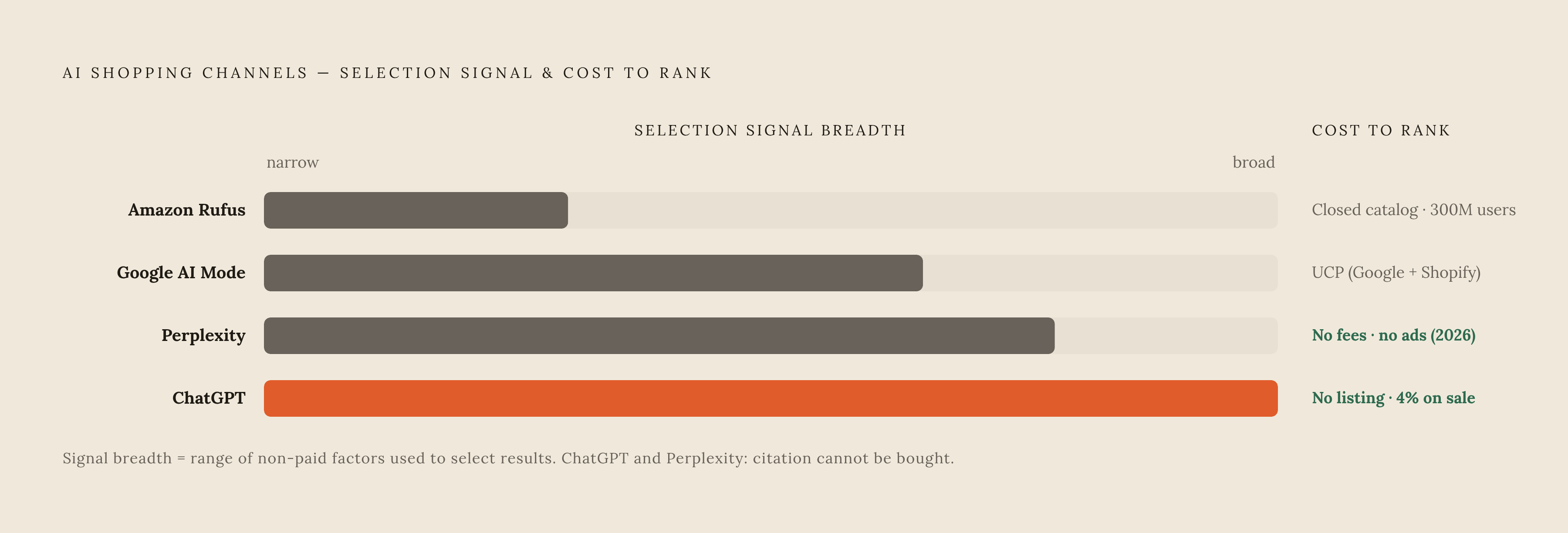
ChatGPT Shopping, relaunched in February 2026 as "Buy it in ChatGPT," now covers more than 1 million Shopify merchants, including Glossier, SKIMS, Spanx, and Vuori. Its selection logic weighs authoritative list mentions, awards, and review volume as key factors. Commerce runs through ACP, the Agentic Commerce Protocol built with Stripe, charging a 4% transaction fee plus standard payment processing, with no listing fees and no way to pay for boosted placement. Brands cannot buy their way into this one. Citation gets earned through data quality and third-party mentions, full stop, and that's a harder sell to a marketing budget than a paid placement line item ever was.
Google AI Mode wants current product identity, price, and availability as a baseline, then rewards deeper variant, attribute, shipping, returns, and review data stacked on top. It's actively expanding what it asks for, adding conversational product attributes for Q&A and reporting on which terms and intents show up in conversational queries. Research has found that pages cited by AI Mode tend to carry structured data. Commerce runs through UCP, the Universal Commerce Protocol built with Google and Shopify, covering discovery through checkout in one pipeline.
Perplexity skews far more research-heavy than ChatGPT. Buyers show up there to compare options and weigh trade-offs before committing, not to get a fast single answer. That rewards content-rich, authoritative pages and synthesizes across the open web, which makes catalog depth and third-party authority, reviews, and editorial mentions, decisive factors in how products get surfaced there. There are no listing costs, no commissions, no transaction fees, and Perplexity dropped all advertising in 2026. It's the channel with the lowest barrier to entry and the one where authority alone does the most work.
Amazon Rufus serves 300 million users inside Amazon's own catalog. For brands with an Amazon presence, attribute completeness within Amazon's own taxonomy is the entire readability question, since Rufus operates in a closed environment rather than crawling the open web.
ChatGPT currently drives the largest share of AI referral traffic, and it's tempting to optimize for that channel alone. Don't. The underlying fix, structured, complete, accurate product data, lifts a brand's position across every one of these channels at once. Solve it once and it travels without extra work per channel.
What a machine-readable product page audit covers in practice
Paz.ai's February 2026 guidance starts in a sensible place: score a set of representative product pages before picking an integration path. An audit's job is to surface gaps, not to justify a rebuild. It doesn't require touching a single line of theme code first, and treating it as a prerequisite for bigger work only delays the fix that actually matters.
Four things get checked, and they're not weighted evenly. Schema completeness asks whether JSON-LD is present at all, whether it covers product identity, pricing, availability, reviews, and shipping, and whether deprecated types like FAQ or HowTo schema are still sitting there doing nothing. Attribute completeness asks whether pages surface the materials, compatibility, dimensions, and care details that match how people actually phrase requests, or only the fields a brand's internal taxonomy happens to track. Policy legibility asks whether delivery windows, shipping costs, and return terms sit in machine-comparable fields, or stay buried in paragraph copy and linked documents nobody parses. Data freshness asks whether price and availability update fast enough to keep agent recommendations accurate, or whether the live page quietly drifts from what the feed reports.
Paz.ai also lays out four operating risks to track as ongoing metrics, not one-time findings filed after a single audit. A low found rate on priority queries reveals product invisibility. A mismatch rate between price or availability on the feed versus the live page reveals stale product decisions actively being served to shoppers. A failure rate in agent verification and purchase mandates reveals unsafe authorization. AI-referred conversion and contribution margin, measured against a brand's own baseline rather than an industry average, reveal weak unit economics that a generic benchmark would hide.
The metric that matters most is changing, too. Click-through rate was the currency of the search era. In agentic commerce, the number that counts is AI citation rate: the tenant actually retrieves, references, or recommends the inventory during fulfillment. Catalog data drifts, schema requirements shift, and channel feed formats change underneath a brand without warning. An audit run once and filed in a drawer becomes useless the moment any of those three things move, and that tends to happen faster than most teams expect.
How brands operationalize machine-readability without a theme rebuild
Most brand operators hear "structured data," "JSON-LD enrichment," and "agent-optimized feeds" and assume it means a developer sprint, a theme rebuild, or a full migration to a new platform. That assumption is understandable, and it's also wrong.
The model that actually works looks different: one brand intelligence layer, trained once on a catalog, policies, reviews, and voice, deployed across every surface, ChatGPT, Google AI Mode, Perplexity, and the brand's own site, requiring no separate custom integration built for each channel and leaving the storefront theme untouched.
Speed decides who wins here, not sophistication of the tooling. The value of being agent-ready gets measured by how fast a catalog goes live, plain and simple, because every week it sits unparseable to AI agents is a week of citations lost. The traffic and conversion lift that rides along with those citations goes instead to whichever competitor solved this first.