Post-Click Experience Gaps That Inflate Bounce Rate
Most DTC bounce rates stem from weak post-click pages, not bad traffic targeting.
What the conversion numbers say about how much is being lost
Bounce rate isn't telling operators what they think it's telling them. Most DTC teams read a rising bounce rate as a traffic problem, evidence that the wrong people are clicking the ad, and respond by routing more budget into acquisition. That's the wrong fix for the wrong diagnosis. Bounce rate is a readout of what happened after the click, and the fix almost always lives on the page, not the media plan.
Start with the anchor number. Across 19 stores tracked between July 2025 and June 2026, the median DTC site converted at 1.17%, with an interquartile range of 0.92% to 1.52%, the figure to measure against rather than the mean. That's the figure to measure against. The mean across the same panel was 1.61%, and on its own, it misleads: two low-AOV, impulse-purchase stores converted at 4.14% and 7.12%, dragging the average up and making a perfectly healthy 1.3% store look like a laggard when it's actually sitting above the midpoint.
Add-to-cart rate across the panel ran about 6.8%, while cart abandonment runs high across ecommerce broadly. That pairing turns the story operational rather than abstract. Shoppers are reaching the point of expressed intent, in real numbers, and then leaving. Nobody who abandons a cart was a targeting failure. They were a real shopper who hit a wall somewhere between "add to cart" and "buy," and that wall sits on the page, not in the audience.
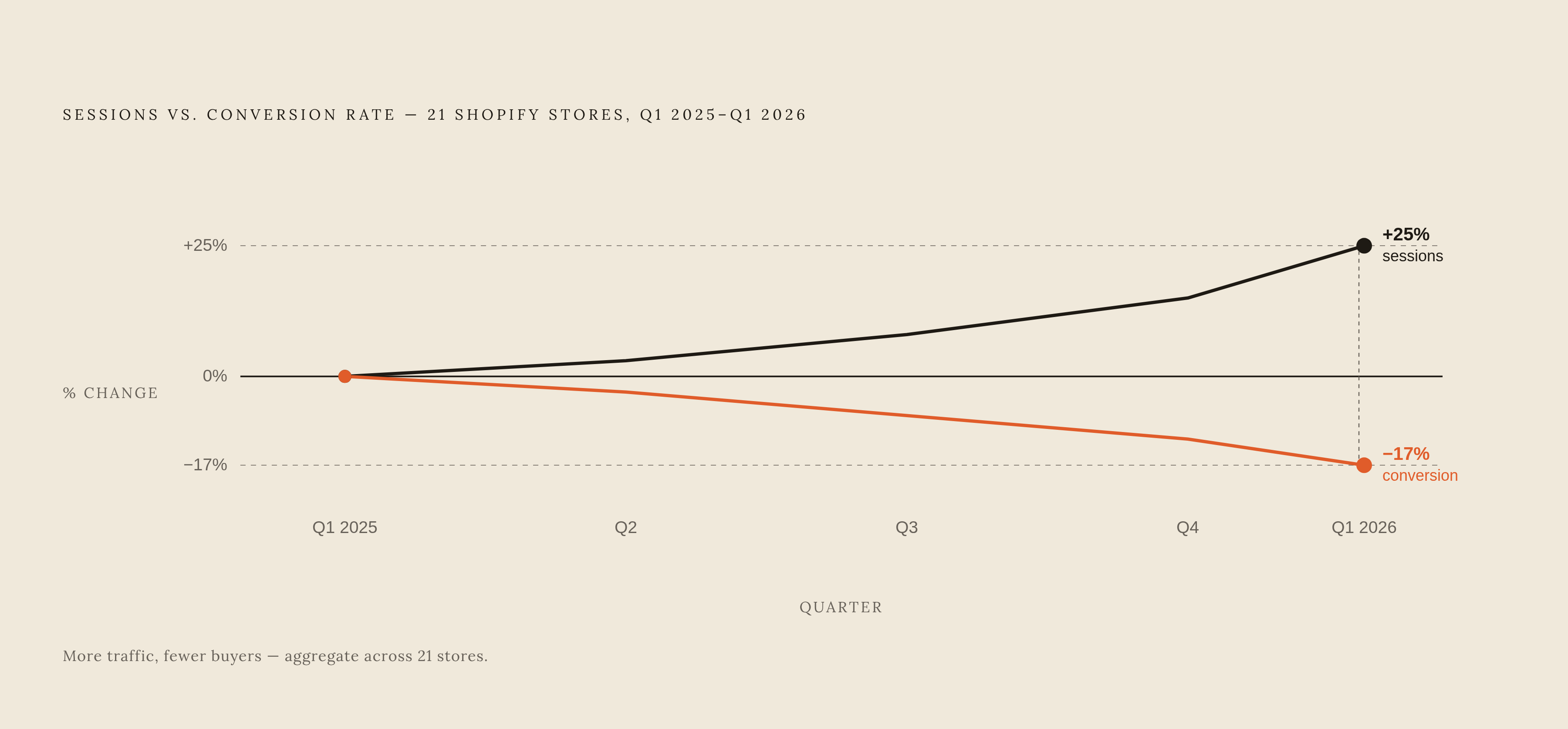
The trend line makes the case harder to argue with. Across 21 Shopify stores, conversion rate fell 17% from Q1 2025 to Q1 2026, even as total sessions grew 25% over the same window. More traffic, worse conversion, at the same time. Broader paid acquisition brings in a wider mix of intent, and when the on-site experience doesn't hold up its end, blended conversion rate absorbs the damage while the media plan gets credit for growth it never actually produced.
The message-to-page mismatch that kills intent before the page loads
Picture the ad: waterproof running shoes for flat feet. Picture the click landing on a category page with 200 SKUs and no filter applied. The shopper's narrow, specific intent just met a generic, undifferentiated answer, and whatever promise the ad made evaporated the moment the page rendered.
That's a routing failure. Nobody bounces because a page looks bad. They bounce because the page answered a different question than the one they asked.
The pattern appears in a handful of predictable places. Paid social ads built around one use case or one promotion land on the homepage instead of a matching page. Search ads targeting long-tail queries dump traffic onto broad category listings that never narrow to the thing the shopper searched for. Email and SMS campaigns link to a product page that's since changed price or gone out of stock, so the offer in the message no longer matches the offer on the page. Seasonal landing pages stay live well after the promotion ends, so retargeted visitors arrive confused about whether the deal still exists.
The audit here is mechanical. Put the ad headline next to the landing page headline. Ask whether the first thing visible on the page confirms what the shopper came looking for, or forces them to search again on a site they've never used before, with the patience from the click already spent.
Thin product pages and the content gaps that stop shoppers mid-decision
A shopper who reaches a product detail page has already done the hard part. They clicked, they didn't bounce off the category page, and they've expressed real intent. At that point, the page's only job is removing every remaining reason to hesitate.
Thin content is easy to spot once it's named. One or two product photos, no lifestyle or in-context shots. A description that repeats the product name, lists a few dimensions, and never answers whether the thing will actually work for the person reading it. Missing size, fit, material, or compatibility details send the shopper to a search engine to find the answer elsewhere, often for good. A review section sitting empty, or with very few entries, at a point where any social proof meaningfully lifts purchase probability compared to none.
The review signal deserves its own line, because the data on it isn't subtle. The vast majority of consumers read reviews before buying. A well-reviewed PDP and a bare one are running two different products in a shopper's mind, even when the item underneath is identical.
AI shopping engines read structured product data, not visual polish, and that changes what "thin content" actually costs a brand. A page missing the specifics a human might forgive while scrolling past a nice photo is a page an AI agent can't parse. It doesn't overlook the gap the way a person might. It skips the product.
Page speed as a conversion tax most brands are silently paying
Speed is the strangest gap on this list, because the shopper never experiences the failure directly. She doesn't see the messaging mismatch, doesn't hit the thin description, doesn't reach checkout and get surprised by a fee. She just leaves, usually without registering why.
Treat it as a tax on media spend already paid. Every second of load delay compounds the cost of a click that already cleared the auction. The page simply didn't earn what the ad spend purchased.
Mobile is where this bites hardest. Mobile sessions make up the majority of ecommerce traffic, yet mobile conversion trails desktop by a wide margin, and mobile cart abandonment runs around 80%, against a global cart abandonment rate of 70.19% per the Baymard Institute's meta-analysis of 50 studies. That gap between mobile and desktop is a page-weight story as much as anything else, and it happens to be the fixable kind.
The usual culprits repeat across DTC storefronts: unoptimized hero images and video sitting on PDPs, third-party app bloat (loyalty widgets, chat scripts, review embeds) loading synchronously and fighting for the main thread, render-blocking scripts sitting in the page head, theme frameworks retrofitted for mobile instead of built for it from the start.
Checkout friction: where expressed intent turns into a 70% abandonment rate
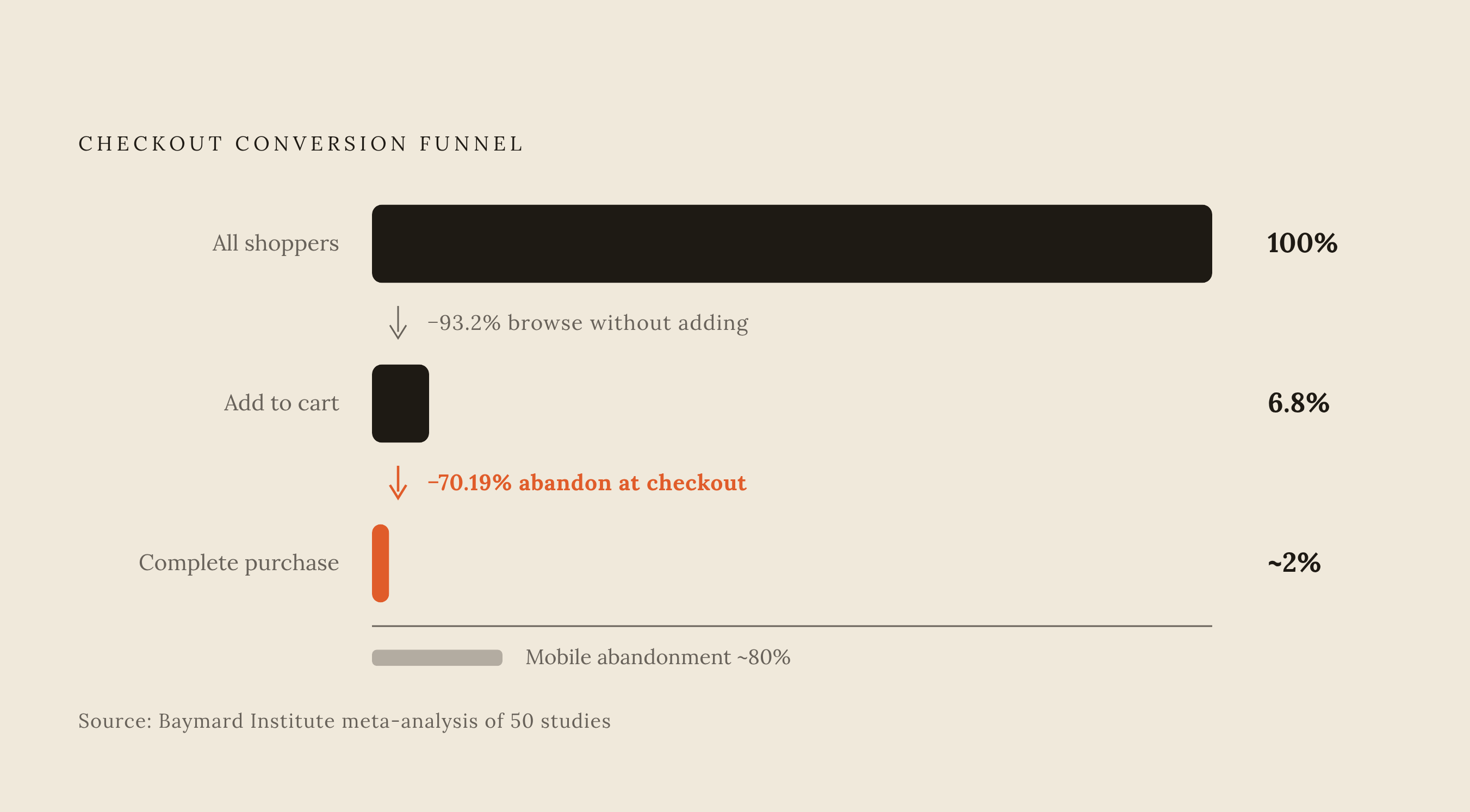
Global cart abandonment is 70.19%. Given that add-to-cart rate runs in the low single digits to begin with, the pool of shoppers who've made it that far is already narrow, and losing 70% of it at checkout is one of the most expensive failures in the funnel relative to how cheap it is to fix.
Checkout abandonment and cart abandonment aren't the same event, and treating them as one metric hides the story that matters most. A shopper who starts checkout and exits partway through has demonstrated higher intent than one who added to cart and never came back. Operators who track these together are averaging away the signal that deserves the closest attention.
The friction points repeat across nearly every DTC checkout that leaks conversion. Forced account creation before purchase is one of the highest-friction gates most stores still run, and it happens to be among the easiest to remove. Unexpected costs (shipping fees, taxes, handling charges that never appeared on the PDP or in the cart) become visible for the first time at the exact moment the shopper is deciding to complete the purchase. Payment options stay limited: no buy-now-pay-later, no express checkout like Shop Pay, Apple Pay, or Google Pay on mobile, where typing card numbers is slow and error-prone to begin with. Form fields multiply past what's needed. Trust signals go missing at the one step where they matter most: no SSL badge, no return policy reminder, no recognizable payment logos.
The surprise-cost failure deserves its own mention, because it's rarely intentional and always costly anyway. A shopper who sees $8 in shipping charges appear at checkout, after the PDP implied free shipping, hasn't been deliberately misled by the brand. She experiences it as deception regardless, and she leaves either way. The cart abandonment statistic absorbs a failure that had nothing to do with pricing strategy and everything to do with sequencing.
The unanswered question at the decision moment: what happens when shoppers need help right now
The gap here comes down to timing, not content. A shopper deciding whether to buy has a real question, about fit, about compatibility, about the return window, about when the order actually arrives, and that question tends to occur at 9pm on a Tuesday, long after support hours end. If the answer isn't already on the page and nobody's available to respond, she leaves, with no guarantee she comes back.
A deflection bot that answers "where is my order" is saving support cost. That's a real function, but it's a different function from the one people constantly lump in with it. An assistant that answers "will this work with what I already own" and then moves the shopper toward checkout is doing something closer to a sales job than a support one. Treating the two as the same product misses what actually drives revenue.
The conversion gap between the two experiences is not small. Shoppers who engage with an AI chatbot convert at meaningfully higher rates than those who don't, a difference that changes the underlying economics of what the on-site experience is worth.
Conversational tools that step in before a shopper exits can address the specific objection forming in real time, before it turns into a bounce. Proactive abandoned-cart conversations can re-engage shoppers who would otherwise be lost, with a meaningful share of those re-engaged going on to convert. That's a small slice of traffic doing outsized work.
Trust signals that are missing or arriving too late in the session
Trust doesn't get settled at checkout. It builds, or fails to build, across the entire session, and a shopper who isn't confident in the brand by the time she reaches the cart will find a reason, any reason, to abandon at the last step.
The failures cluster in predictable spots. Reviews absent, or sitting below the five-entry floor that meaningfully moves purchase probability. Shipping and returns terms buried in a footer link nobody clicks, instead of stated on the PDP. No visible social proof near the add-to-cart button: no purchase counts, no recent-buyer notifications, no star rating sitting in the shopper's direct line of sight. Security badges and payment trust marks that only show up on the checkout page, arriving well after the shopper's opinion of the brand has already formed.
A marketplace listing borrows trust from the platform underneath it. A DTC site doesn't get that inheritance, because it's the only place a shopper can evaluate the brand directly, which makes thin trust signals a DTC-specific liability, not a generic ecommerce one. It's the only place a shopper can evaluate the brand directly, which makes thin trust signals a DTC-specific liability, not a generic ecommerce one. If that evaluation comes up short, the shopper doesn't hesitate: she goes and finds the same product on a platform where the trust signals are already familiar, and price alone won't win her back from that.
User-generated content carries more credibility than brand copy ever will, structurally, because it comes from someone with nothing to sell. Given how consistently consumers seek out reviews before buying, placement matters as much as the reviews themselves. Putting them directly on the PDP, instead of tucked behind a separate tab, turns a behavior shoppers were already going to do into a conversion lever, rather than one more click standing between them and a decision.
The same gaps that lose human shoppers are now losing AI-referred traffic too
The audience buying from DTC stores has already shifted. Roughly 73% of consumers report using AI agents or AI-powered assistants somewhere in their purchase journey, and AI-referred traffic to US retail sites rose roughly 393% year over year in Q1 2026. That traffic is arriving now, and most PDPs aren't built for it.
AI agents don't browse the way people do. They read data, not design, and the thin product descriptions, missing schema markup, and unstructured attributes a human shopper might forgive while scrolling past a nice photo are exactly the details an AI agent can't work around. The brand with more structured, more complete product data wins the citation. The brand without it doesn't get considered.
Audit data shows a majority of brands that rank well on Google aren't cited by AI systems. Ranking and being recommended have split into two separate problems, and they get solved by two different sets of fixes, not one SEO checklist stretched to cover both.
The mechanism connects directly back to everything above it. The same PDP gaps that make a human shopper bounce (no sizing information, no clear use case, no visible return terms) are the gaps that make an AI agent either skip the product entirely or guess at details it can't confirm. Both outcomes end the same way: no sale, and no record that a shopper was ever there.