Sequential Testing for DTC Brands Without A/B Testing Tools
Small DTC stores can test changes using before-and-after comparisons instead of A/B tests.
Most direct-to-consumer brands cannot run meaningful A/B tests. Their traffic is too thin to split cleanly, and the result is months of inconclusive experiments that leave conversion rates exactly where they started. Sequential testing offers a different path: a disciplined before-and-after comparison run against the store's own baseline, requiring no specialized tooling and producing decisions a small team can actually act on.
Why most DTC brands cannot run standard A/B tests and what that costs them
A concurrent A/B test needs a pre-committed sample size, and you have to resist peeking at results mid-test. Below a meaningful revenue threshold, a brand rarely has the sessions to fill both variants in a reasonable window. The mathematics that give a large retailer confidence give a smaller store noise, and the operator watching a dashboard for a week sees nothing definitive either way.
The cost is not wasted time alone. The deeper problem is the absence of a research-backed process before the test. Ideas borrowed from another brand's audit have no research basis for the store running them. Without enough traffic to split cleanly, operators fall into decision paralysis, making gut calls or freezing entirely, and neither compounds.
What sequential testing actually is and how it differs from A/B testing
Sequential testing monitors an experiment continuously as data accumulates, using adjusted significance thresholds at each interim look. It can stop early once a result is statistically valid instead of waiting for a pre-fixed sample size or end date. Continuous monitoring platforms use these protocols because they cut testing time but keep statistical discipline.
If you run a small DTC store, this method matches instincts you already have. Make a change, hold everything else steady, watch what happens. Sequential testing adds the discipline of a defined window and a pre-set decision rule to that intuition. The comparison is not Variant A against Variant B running simultaneously. It is after the change versus before the change, under conditions as similar as possible. That framing also aligns with how channel-level incrementality hierarchies work: test at the broadest level first, channel on or off, then narrow to tactic, campaign, and creative, with each step discrete and time-bounded.
Why the baseline comparison is the hardest part to get right
The integrity of a sequential test lives entirely in the quality of the baseline period. If confounding variables contaminate the before, the after comparison is meaningless. Attribution confusion makes baselines treacherous: Meta, Google, and email each use their own attribution windows, so aggregate platform-reported revenue routinely exceeds actual store revenue. The baseline must come from store-level figures, not platform dashboards. A brand's own system of record, unclouded by third-party attribution windows, becomes the ground truth for what actually moved the needle.
Seasonal spikes, promotional events, a viral social moment, a platform algorithm shift, or a supplier stockout can all move revenue independently of the variable being tested. A baseline window should be equivalent in length to the planned test window and fall in a comparable period: same day-of-week mix, no major holidays or sale events on either side. Practically, that means establishing the baseline before touching anything else.
The research step that must come before any test is launched
What separates testing programs that compound from ones that stall is whether research came before the test. A variable chosen without evidence is as likely to move nothing as to move revenue. SplitBase's framework, applied to brands like Dr Squatch, L'Oréal, and Transparent Labs, uses a 3Ps structure called Patterns, Perception, and Proof that must exist before a test is designed. Perception tells you the why behind the behavioral signal with post-purchase surveys, review mining, and customer interviews. Proof addresses structural friction: broken flows, slow pages, confusing navigation that quietly suppresses conversion without showing up in aggregate metrics.
For a brand without dedicated tools, these inputs are free or nearly free. The output of research is a prioritized hypothesis, a specific behavior observed on this store that suggests a specific change, not a test idea borrowed from a blog post. Without this step, even a well-executed sequential test teaches nothing. A win cannot be explained, a loss cannot be diagnosed, and the next test has no foundation.
A repeatable hierarchy for choosing what to test in what order
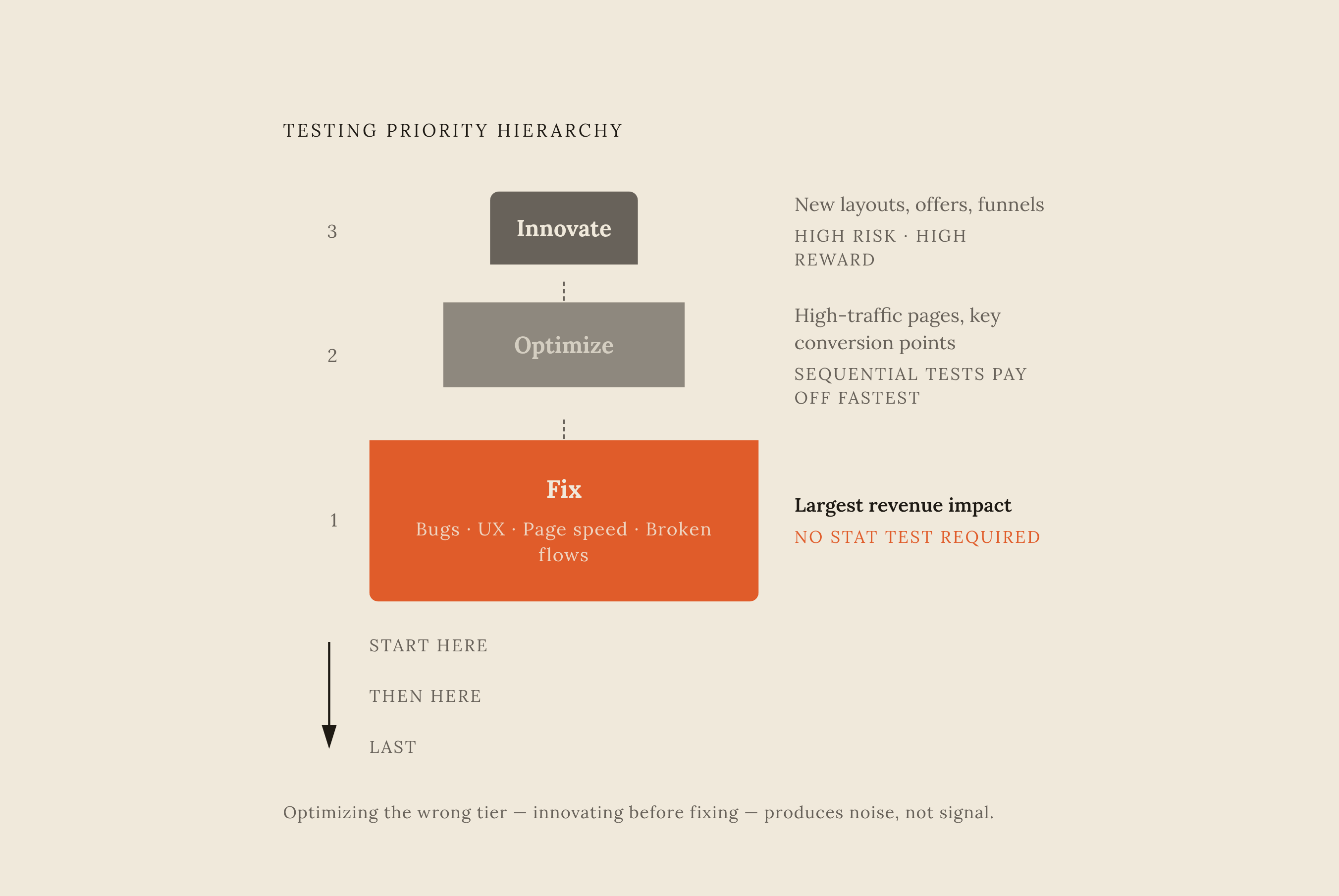
Not all variables are equally worth testing, and testing them in the wrong order wastes cycles. The hierarchy runs from what is broken, to what is working but underoptimized, to what is innovative. SplitBase's CRO hierarchy makes the order explicit, and sequential testing discipline enforces it naturally. Fix what is broken first: bugs, UX issues, page speed, broken flows. These are boring and critical and always come first because they have the largest addressable revenue impact and require no statistical test to justify. Then optimize what is working: high-traffic pages, key conversion points, steps most users actually complete, where measurable revenue lives and where sequential tests pay off fastest. Innovate last, with new layouts, new offers, and new funnel structures that carry high risk and high reward but are useless if the foundation is broken.
For DTC brands, the channel-level hierarchy follows the same logic. Test whether a channel drives incremental revenue before you optimize within it, and test tactic, brand versus non-brand or prospecting versus retargeting, before creative or audience. Each level of the hierarchy is one sequential experiment: one change, one window, one decision before moving to the next level. If you jump straight to testing a new product detail page layout before fixing a broken mobile checkout, you are optimizing the wrong variable, and the sequential testing window will show noise rather than signal.
How to structure a single sequential test from setup to decision
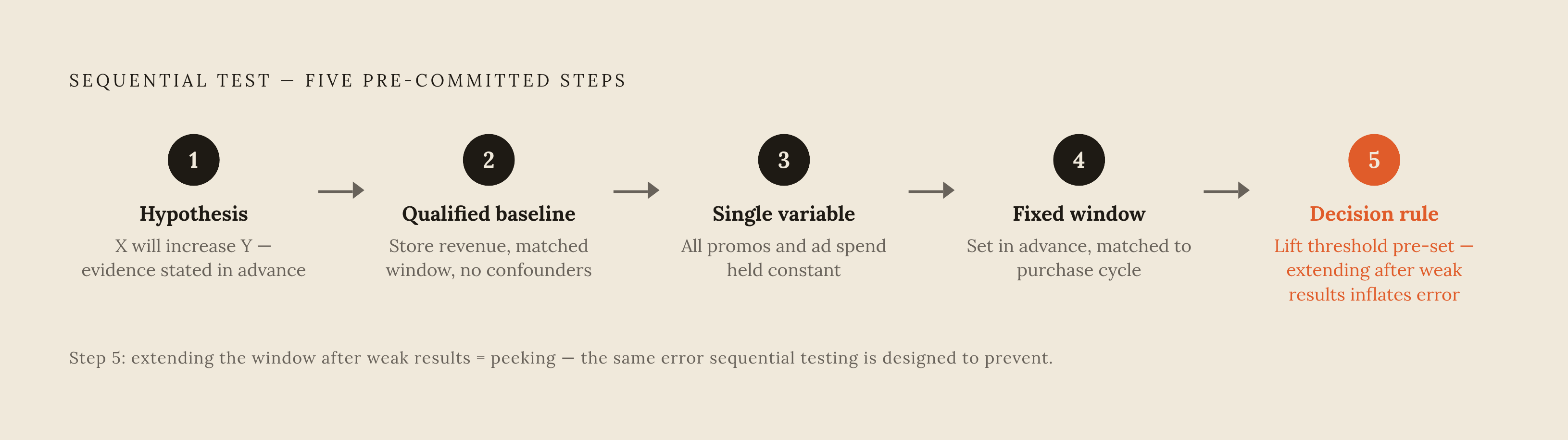
A well-structured sequential test has five components: a pre-defined hypothesis, a qualified baseline, a single variable changed, a fixed measurement window, and a pre-set decision rule. Each must be written down before the test begins. The first step is writing the hypothesis in a form that forces specificity: changing a specific element will increase a specific metric because of evidence from research. If the because cannot be filled in from actual observation of this store, the test is not ready. The second step is qualifying the baseline. Pull store-level revenue, not platform-attributed revenue, for an equivalent prior period with the same length and comparable seasonality and no confounding promotions. Write down every active promotion, ad spend level, and external factor during the baseline so you can hold them constant in the test window.
The third step is changing one variable only. Pause or hold constant all other active experiments, promotional changes, and major ad spend shifts for the duration of the test window. The fourth step is defining the measurement window in advance. The window length should match the brand's average purchase cycle: shorter for fast-turn consumables, longer for considered purchases that require deliberation time. Pre-commit to the window length before the test starts, because extending it after weak early results is the sequential-testing equivalent of peeking and inflates error rates. The fifth step is pre-setting the decision rule. Define a meaningful lift in store-level revenue before the window opens, and treat a directional improvement below that threshold as inconclusive rather than a win. Early stopping is permissible if the pre-set threshold is reached convincingly before the window closes, but the threshold must be set in advance, never chosen after seeing results. Document the outcome as a win, loss, or inconclusive before moving to the next variable, because a loss or an inconclusive result is as useful as a win if it is diagnosed and fed back into the research step.
What metrics to track and where to pull them without dedicated tooling
The right metric for a sequential test is revenue per session at the store level, not conversion rate alone and not platform-reported ROAS. Revenue per session captures both conversion and order value in one number that cannot be gamed by attribution windows. Track conversion rate and average order value as secondary diagnostics. If revenue per session improves, check whether more conversions or larger baskets drove it, because that informs the next hypothesis. Do not use platform-reported ROAS or attributed revenue as the test metric, because attribution windows mean the same conversion can appear in Meta, Google, and email simultaneously, making platform numbers unreliable for before-and-after comparison.
For channel-level sequential tests where you turn a channel on or off, the metric is total store revenue in the test window versus the baseline, not channel-reported revenue. The useful free or low-cost data sources are readily available. Google Analytics 4 gives you revenue per user, page-level engagement, and checkout funnel drop-off. A simple comparison template is a spreadsheet with baseline period columns for dates, sessions, revenue, revenue per session, conversion rate, and average order value beside test period columns. The delta between them is the signal.
How the product detail page became the highest-leverage place to start testing
For most DTC brands, the product detail page is the highest-leverage surface for sequential CRO testing because it is where both organic and AI-referred shoppers arrive with purchase intent and must be converted immediately. AI-referred shoppers now land on product detail pages, not homepages or category pages, a pattern called buyer journey compression. AI search collapses discovery and consideration into one query and puts high-intent buyers directly on the product page. That means PDP optimization is not just a CRO priority. It is also the brand's primary interface with AI-mediated shopping traffic, which arrives with higher intent than organic search traffic.
The sequential tests worth running on the PDP follow the fix-optimize-innovate hierarchy. Fix mobile checkout friction, page load speed, broken size or variant selectors, and missing product information that forces a shopper to leave to get an answer. Then optimize product description copy rewritten to answer the specific questions buyers actually type, not keyword-stuffed prose but direct answers to what the product is made of, who it is for, and how it compares to common alternatives. Then optimize review count and recency, because thin review coverage hurts conversion with human shoppers and with AI recommendation systems that use review signals as a trust proxy. Innovate last with new page layouts, social proof treatments, or on-site AI sales experiences that answer shopper questions in real time. Each of these is a discrete sequential test: one change, one window, one decision. The hierarchy prevents the common mistake of redesigning the entire PDP at once and losing the ability to attribute any revenue movement to a specific change.
AI shopping agents read data, not design. They require complete structured fields such as availability and GTIN, recommended variant attributes like material, size, and color, server-rendered schema markup on every product page, and accurate descriptions that answer specific buyer questions. Catalogs that store key product attributes in images, PDFs, or unstructured description prose fail the machine-readability test. The attribute is effectively invisible to AI shopping agents, which parse structured feeds and schema markup rather than images, PDFs, or prose.
How to read results honestly and decide when a test has taught you enough
The most common failure in manual sequential testing is not the test itself but the decision. Operators call inconclusive tests wins when results trend positive, or they abandon valid experiments before the pre-set window closes. An inconclusive result, revenue per session moving in the right direction but not by the pre-set meaningful threshold, is a valid outcome. It means the variable did not move the needle enough to justify keeping the change, and the hypothesis needs revision before re-testing. A loss requires diagnosis before the next test. Was the variable genuinely the cause, or did a confounder enter the window? Check ad spend, promotions, and external events before you conclude the change hurt revenue. A win must be documented with the same rigor as a loss: what changed, over what window, against what baseline, by how much. That record becomes the research input for the next hypothesis.
The temptation to extend a window after seeing weak results is the sequential-testing equivalent of peeking in A/B testing. It inflates the chance of calling a noise pattern a win, and the pre-set window closes when it closes. Every test, win, loss, or inconclusive, feeds back into the research step and tightens the next hypothesis. That is the compounding mechanism that separates brands with a testing program from brands that run occasional experiments. Testing is cyclical, not sequential: research feeds testing, testing generates research, and the loop never stops. The output is not just a win or a loss but a new pattern.