Affiliate and Influencer Traffic Landing Page Personalization
Pre-sold visitors need landing pages that confirm, not persuade.
Affiliate and influencer traffic behaves nothing like paid search traffic, and treating the two the same is the single most common way brands waste a high-intent visitor. One arrives cold while the other arrives already convinced, and that trust gap separates affiliate and influencer traffic from paid search traffic.
Why affiliate and influencer traffic is fundamentally different from paid search traffic
A visitor who clicks through from a creator's post or an affiliate link has already done the hard work of deciding to care. Someone they follow, someone whose taste or judgment they've chosen to rely on, has already walked them through the awareness and consideration stages that most marketing exists to produce. The landing page doesn't meet a stranger. It meets someone who has outsourced part of their buying decision to a person they trust, and who now expects the brand to pick up exactly where that person left off.
That's structurally different from paid search. A search visitor's intent gets inferred from a keyword: someone typed "best protein powder for recovery" and a brand bid to show up in front of them. There's no emotional context attached, no specific framing of the product, no third party's credibility riding on the outcome. Influencer and affiliate traffic carries all three. The visitor knows what the creator said, how they said it, and why they believed it. They arrive with a specific promise already in their head.
A generic landing page throws that away. If the page doesn't acknowledge where the visitor came from, if it opens with the brand's default pitch instead of picking up the thread the creator started, it resets the clock. The visitor who was moments from converting now has to re-evaluate the brand from scratch, and every point of trust the creator built goes uncashed.
How AI assistants are compressing the affiliate journey before the click even happens
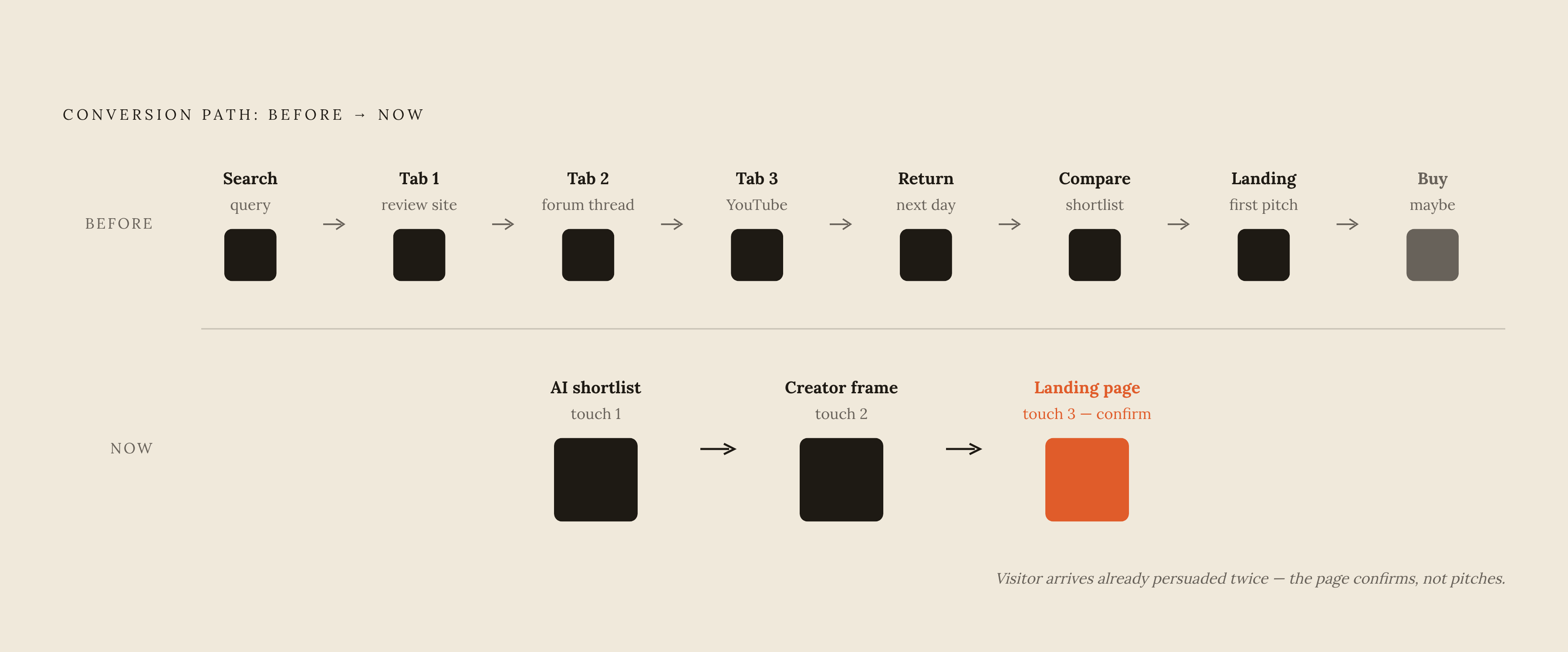
The pre-sold state described above increasingly forms before the visitor ever reaches the creator's content, let alone the landing page. AI assistants are now doing a chunk of the research and comparison work that used to happen across multiple browser tabs and multiple days. A shopper might ask an AI assistant to compare recovery supplements, get a shortlist with reasoning attached, then go looking for a creator's take on the one that stood out. By the time they click an affiliate link, they've already had a product recommended to them, had its merits explained, and arrived at something close to a decision.
This compresses what used to be a multi-stage journey into something closer to a single confirming motion. The visitor isn't browsing anymore by the time they land on the page; they're checking.
That changes the job of the landing page in a specific way. It no longer needs to build a case from zero. It needs to confirm what the visitor already believes and remove anything that might introduce doubt. A page built to persuade a skeptic will actually slow down a visitor who has already been persuaded twice over, once by an AI assistant and once by a creator. The gap between what the visitor expects to see and what the page actually shows them has gotten wider, and that gap is now the single biggest lever on whether the visit converts or stalls.
Message-Match and the Referring Source's Tone, Promise, and Context
Message-match means the first thing a visitor reads on the landing page has to echo the specific language, promise, and framing used by whatever sent them there, not the brand's standing marketing copy. This sounds like a simple continuity rule, and it is, but it gets more demanding with affiliate and influencer traffic because the referring source isn't neutral. It has a voice, an audience, and a set of expectations baked into both.
A tech reviewer's audience wants specs, comparisons, and a reason the product wins on a measurable axis. A lifestyle creator's audience wants aspiration, a sense of what life looks like with the product in it, and social proof that other people like them have already bought in. A fitness creator's audience wants transformation framing: before and after, effort and payoff. None of these three audiences will respond to the same landing page, because none of them clicked through expecting the same thing.
The failure mode appears the moment the visitor reads the headline. If it doesn't echo the specific hook the creator used, the visitor's brain registers a mismatch instantly. They start to wonder if they clicked the wrong link, or if the brand on this page is actually the one the creator was talking about. That moment of doubt is where trust drops and where bounce happens. It costs almost nothing to prevent and costs almost everything when it's missed, because there is rarely a second chance to re-earn that attention on the same visit.
The structural elements that carry message-match into the page experience
Message-match is not a matter of swapping one headline for another and calling the job done. It runs through a hierarchy of page elements, and each one either reinforces the promise the creator made or quietly undercuts it.
The headline carries the most weight because it's the first thing read and the fastest place a mismatch gets noticed. It needs to echo the specific framing the creator used. If the creator said a moisturizer saved their skin through a rough winter, the headline should speak to that outcome directly. Leading with an ingredient list instead answers a question the visitor never asked.
The call to action has to reflect what the visitor was told they'd do next. If the creator pointed people toward a free checklist, the button should say "get the checklist," not a generic "learn more." If the pitch was about recovering faster, the button should say something closer to "start recovering sooner. Small as this sounds, a CTA that doesn't match the promise forces the visitor to re-translate what they're supposed to do, and that friction lowers conversion rates.
Imagery needs to match the visual register the visitor just came from. Someone arriving from Instagram or TikTok has been looking at motion, at high-affect, fast-cut content, and a static product photo feels like a step backward. Someone arriving from a blog post is used to slower pacing and expects context: the product in use, shown with enough detail to support the kind of reading they were just doing. Matching the register keeps the visual experience continuous.
Offer framing matters just as much. If the creator mentioned a specific discount, a bundle, or a bonus, that offer needs to be visible the moment the page loads. Burying it below the fold, or worse, not including it at all, reads as a bait-and-switch, even when nothing was ever misrepresented. The visitor remembers what they were told, and the page's job is to make good on it immediately.
Finally, every form field, every extra step, every decision point the page introduces that the creator never mentioned counts as an unearned ask. The test is simple: was the visitor prepared for this before they arrived? If a creator's post made no mention of creating an account before checkout, asking for one at the point of highest intent introduces friction the visitor didn't sign up for, and friction at that moment is where a lot of pre-sold visitors quietly leave.
How dynamic personalization scales message-match across many creators without building dozens of bespoke pages
The obvious objection to all of this is operational. A direct-to-consumer brand running ten affiliate relationships cannot realistically build and maintain ten separate landing pages, let alone fifty. Hand-building a page per creator doesn't scale past a handful of partnerships, yet most brands run more than that.
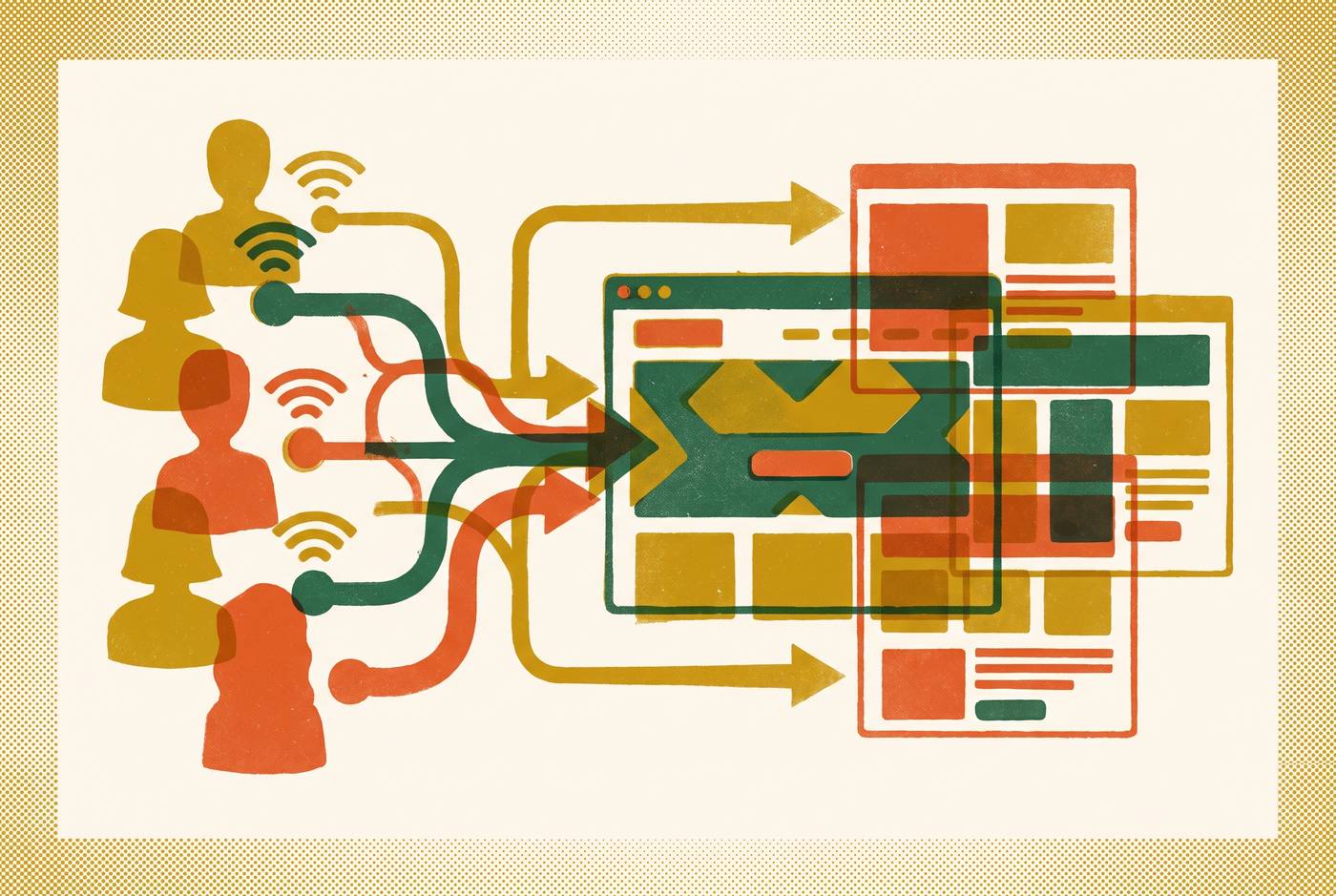
Dynamic personalization is the answer: a system that reads UTM parameters, referrer data, or audience segment signals and serves matched headlines, imagery, proof blocks, and calls to action automatically, without a human rebuilding a page every time a new creator comes on board. One underlying page template does the work that used to require a dozen separate builds.
A fitness creator promoting a protein powder shows how this plays out in practice. That creator's audience is several audiences, arriving through different formats with different expectations. Someone who clicked through from an Instagram story is moving fast and responds to a quick, high-energy video testimonial. Someone who found the same recommendation through a long-form blog post is reading slower and wants a study-referenced explanation of why the product works. A system built on audience segment signals can show each of those visitors a different version of the same underlying offer, matched to the pace and depth they already expect, without the brand hand-coding either version separately.
None of this works unconditionally, though, and the honest constraint matters as much as the capability. Personalization lifts conversion when the segments being served are genuinely different from each other and when there's enough traffic in each segment to confirm the variant is actually working and not just looking different by chance. Applied to a trickle of visitors too small to produce a reliable read, dynamic personalization doesn't outperform a single, well-written page. It just adds complexity without adding proof. The operating rule is to personalize only where three conditions line up at once: the segment is large enough to measure, the variants show meaningfully different content, and the measurement setup can actually tell the variants apart.
Clean, well-structured product data is the factor underneath that personalization layer that's easy to overlook, since it determines the quality of what feeds the system. AI assistants that pre-qualify shoppers before they ever reach a creator's content do that by reading a brand's product titles, descriptions, feature bullets, structured attributes, reviews, and FAQs. A brand whose data is thin or disorganized in those fields gets described incompletely to the shopper asking the AI assistant for a recommendation, or goes unmentioned. The review signal is a specific version of this problem: products with few reviews or weak ratings appear less often in AI recommendation output, because these systems use review volume as a trust proxy. Clean structured data is the strongest single predictor of whether a product gets recommended, and it can partly make up for a weak review profile, but real review volume still needs to feed the system.
Measuring whether landing page personalization is working
Knowing whether any of this is paying off is complicated by a measurement problem that affects most affiliate and influencer programs. Multiple platforms routinely claim credit for the same sale at the same time. An affiliate platform logs a conversion, a paid social platform logs the same conversion, and a search platform logs it again, and the combined total across all three ends up larger than the revenue the brand actually took in.
Last-click attribution makes this worse specifically for influencer and AI-assisted traffic. If an AI assistant answered the shopper's questions and a creator supplied the final push toward a specific product, but the shopper's last click before purchase happened to run through a different channel, the system credits that last channel and erases the actual path that led to the sale. The influencer's contribution, and the AI assistant's, simply doesn't appear in the reported numbers, even though both did the work of moving the shopper toward a decision.
The honest way to measure whether personalization is working is to build an engaged-shopper cohort: conversion rate, average order value, and return rate for visitors who arrived through a specific affiliate or creator source, compared against the brand's own baseline for visitors with equivalent intent who didn't see a personalized page. That comparison has to run against the brand's own historical numbers, not against industry benchmarks pulled from somewhere else, because traffic quality and audience composition vary too much between brands for an outside benchmark to mean much.
The same discipline that governs where to personalize should govern how to measure it. Personalize only the variants where the segment is large enough to produce a trustworthy signal. Run the comparison against the brand's own baseline. Supplement whatever attribution platforms report with post-purchase surveys, since those catch the AI-influenced and creator-influenced conversions that click-based attribution tools miss. That combination, a real baseline, segment sizes large enough to trust, and a direct question to the customer about what actually moved them, is what turns landing page personalization from a guess into something a brand can actually improve over time.