Organic Search Traffic Intent Mismatch on DTC Collection Pages
Collection pages built for browsing fail transactional shoppers who are ready to buy.
Intent mismatch on DTC collection pages is an architectural failure, built into how Shopify collection pages render and how AI search surfaces now evaluate what counts as a usable product source, and it converts organic traffic into a revenue drain.
Collection pages are structurally misaligned with transactional shoppers and AI agents
A shopper searching for blue running shoes under a fixed budget has already finished the research phase. That shopper wants confirmation: a price, a stock count, a fit guarantee, something a product page is built to deliver. A collection page filtered by color and category gets close to that experience without ever actually providing it, because a collection page is a browsing surface, and the shopper arriving from that search has already stopped browsing. The mismatch does not live in which keyword the page targets. It lives in which page type the domain serves in response to that keyword. Search intent taxonomy for ecommerce separates commercial investigation (comparing options) from transactional intent (taking action), and each calls for a different page format. A collection page tries to serve both at once, so it ends up satisfying neither fully. Shopify's default filter architecture makes this worse in a specific, mechanical way: narrow a collection down to one or two products through filters, and the resulting URL carries almost no unique text, no structured content, and nothing that distinguishes it from thousands of near-identical filtered URLs elsewhere on the same domain. The page ranks, because it inherits the category's accumulated authority. Nothing about its structure was built to close a buyer who already knows what they came for, so it cannot convert.
How Shopify's filter architecture creates a domain-wide quality problem
The filter URL issue affects more than the individual pages it touches. It degrades the authority signal of the entire domain at the crawl level. Each filtered URL on its own looks like a minor, tolerable weak point: thin text, no unique collection description, no structured schema attached. Multiplied across hundreds or thousands of filter combinations, those same weak points start to read, to a crawler, as evidence that the domain is largely made up of thin, repetitive content. Analysis of D2C brands losing organic traffic identifies this crawl-level dilution as its own compounding factor in domain authority decline, distinct from and additive to whatever is happening on any single page. So if a brand carefully optimizes one collection page for intent but leaves hundreds of filter-generated URLs unmanaged, it is patching one pipe while the rest of the system floods around it. The fix cannot live at the copy level either. If you rewrite a single collection description, that does nothing to fix the thin URLs piling up across the entire domain that crawlers keep reading. The same structural weakness that drags down organic rankings also shapes whether AI search surfaces trust the domain enough to cite it.
What AI search surfaces read on a collection page
AI shopping agents now sit alongside Google as a second evaluator of every collection page a brand publishes, and they read a narrower, more mechanical set of signals than a human browsing the same page ever would. ChatGPT Shopping, Google AI Mode, and Perplexity look for JSON-LD Product schema, complete attribute coverage across core product fields, and server-rendered structured data. None of them reads visual design or navigation menus to decide what to recommend. A collection page built on filtered URLs with minimal text gives an AI agent almost nothing to parse or cite, so the agent moves on and reads a competitor's page that does carry that structured data. Research on D2C organic traffic loss finds that AI search agents get weak authority signals from thin filter-generated pages, and that weakness lowers how often a brand gets surfaced in an organic recommendation. The citation relationship here deserves precision rather than overstatement: pages with structured data correlate with higher Google AI Overview citation rates, yet the largest controlled study on the subject found that adding schema produced no meaningful citation uplift on its own. Pages cited by ChatGPT and Google AI Mode are disproportionately pages that already contain structured data, but that pattern is a correlation, not a demonstrated causal lever, and schema markup alone has not been shown to raise citation rates. None of that makes the channel marginal. ChatGPT Shopping is now available to all U.S. users and connected to millions of Shopify merchants through product discovery, after its original native checkout feature was discontinued. Google AI Mode launched with agentic checkout joined by select major retailers, but it remains in early access with only a limited set of U.S. merchants. These are live, functioning discovery surfaces already routing real shoppers, and the structural failures already damaging organic rankings now damage AI citation eligibility at the same time, through the same missing signals.
How AI Overviews have redistributed clicks across collection-adjacent queries
Reporting on AI Overviews and DTC organic traffic shows that the damage is not spread evenly across query types. Informational and "best of" queries, things like "how to choose," "best [product] for," "[product] vs. [product]," and "is [product] worth it," are absorbing the worst of the click-through rate decline, as AI Overviews answer the question directly and the click never happens. Branded searches and category queries carrying price modifiers are holding within normal seasonal variance by comparison. That split has a precise implication for collection pages. Collection pages that happen to rank for informational or "best of" queries now sit in the worst possible position: they were built to absorb top-of-funnel traffic they were never designed to convert, and that traffic is now being intercepted and answered by AI Overviews before it ever reaches the site. Transactional collection pages, the ones targeting category-level queries with purchase modifiers attached, are the least disrupted by AI Overviews and the most likely to retain their click value. That survival is conditional, though: those pages only keep their value if they actually satisfy transactional intent once the shopper lands. The diagnostic step this creates is specific. Sort a brand's collection pages into those ranking for informational queries, which are structurally losing traffic regardless of what the brand does, and those ranking for transactional queries, which are still receiving clicks but failing to convert wherever the underlying architecture is wrong.
Why the revenue leak stays invisible on standard analytics dashboards
The revenue cost of this mismatch is consistently underestimated, because the tools most brands use to measure organic performance are degraded by the same conditions causing the problem. When a collection page ranks for a transactional query and the shopper bounces without converting, Google eventually reads that bounce signal and demotes the page, but the demotion takes time. In that interim window, the brand's analytics dashboard shows organic sessions that look perfectly healthy, while the revenue that should have come from that channel quietly drains away. Attribution itself is fracturing at the same time. Cross-platform attribution produces substantial revenue overlap when multiple platforms independently claim credit for the same sale, and the measurement environment has tightened further on top of that: Apple's iOS privacy changes and Meta's move to narrower default attribution windows have both reduced the visibility brands once had into which channel actually drove a purchase. A brand trying to measure the true cost of intent mismatch is doing so with instruments that are themselves unreliable. A brand can be losing revenue from intent-mismatched collection pages and missing revenue from AI channels it has no way to measure, with both gaps traceable to the same architectural failure, and neither gap visible in a standard GA4 or Shopify analytics report. The dashboard shows sessions, shows a ranking holding steady, and gives you no reason to suspect anything is wrong. That is precisely the diagnostic blind spot this section describes: the absence of a visible problem is not evidence that the problem does not exist.
The specific architectural signals that distinguish a collection page that converts from one that leaks
A collection page that satisfies transactional intent and earns AI citation differs from a default Shopify collection page in four specific, auditable ways, and most collection pages now in production fail on all four. The first is a unique, query-specific collection description: a static page built for a defined transactional query, something like /collections/blue-running-shoes rather than a filtered URL such as /collections/shoes?filter.v.option.color=Blue, can carry a description that speaks directly to the buyer's stated need, covering material, use case, price range, and the specific facts that let a transactional shopper confirm they have landed in the right place. The second is structured JSON-LD schema: a dedicated static collection can carry JSON-LD Product schema and collection-level schema, which is the machine-readable signal AI shopping agents rely on to parse and cite product data, and a filtered URL cannot carry that schema reliably. The third is complete attribute coverage: AI shopping agents need complete structured data, including GTIN, price, and availability, and benefit substantially from category-specific attributes like material, size, and color, yet most catalogs fail here because the underlying product data lives in images or PDFs rather than in machine-readable fields, meaning that a product with incomplete attributes stays invisible to agent-based recommendation no matter how well the page around it is built. The fourth is crawl-controlled URL structure: static collections paired with canonical tags and proper crawl directives consolidate ranking authority onto a single URL instead of scattering it across hundreds of filter variants, which is the same fix that addresses the domain-wide quality degradation described earlier alongside the individual page's intent problem. Research on D2C collection page architecture points to this static-collection approach, building a dedicated URL for each high-volume filter combination, as the fix that improves agent readiness and organic intent alignment at the same time. The audit that follows from this is concrete rather than theoretical: identify which filter combinations on a given collection carry meaningful search volume, check whether each one currently resolves to a static page or a filtered URL, and prioritize the highest-volume mismatches first for conversion into static collections. AI shopping surfaces, ChatGPT Shopping, Google AI Mode, and Perplexity among them, require complete structured data across these core fields before including a product in a recommendation at all, and a missing attribute, particularly around availability, material, or use-case tagging, disqualifies a product from agent-based recommendation regardless of how well the surrounding page is otherwise built. There is an upside to getting this right that a keyword-by-keyword approach misses entirely: AI shopping agents aggregate what shoppers are actually asking for in ways conventional keyword tools do not capture, surfacing queries that combine product type, a technical spec like wireless standard, and a threshold like battery life, demand that no individual product listing was ever written to match word for word. A brand with complete, structured attribute data can still get surfaced by an agent matching those combined criteria, even if it never ranks for that exact phrase in a traditional search result.
How collection pages should be evaluated in AI-mediated shopping
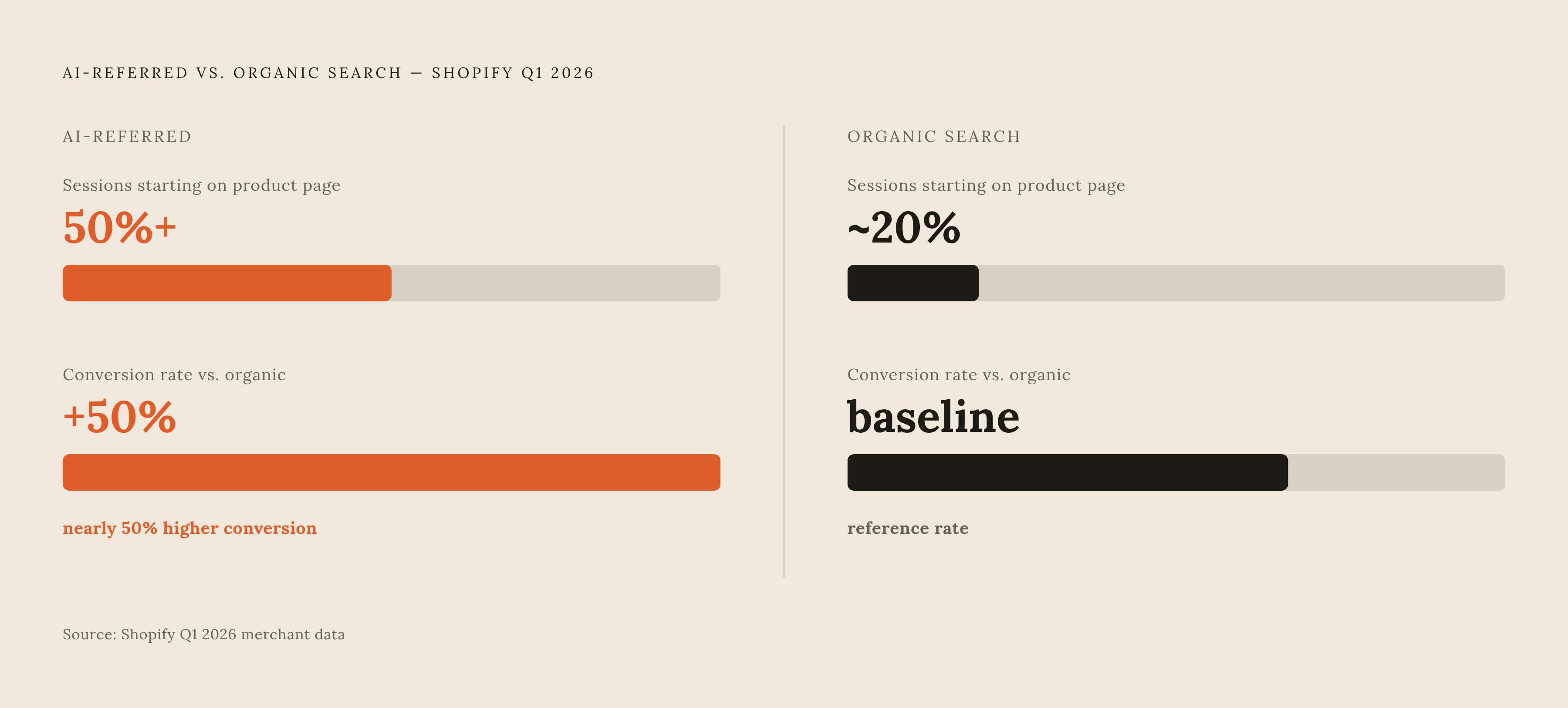
In an AI-mediated shopping environment, a collection page now has two audiences: a buyer who arrives already pre-qualified from an AI conversation, and the AI agent that decided whether to send that buyer. Shopify's Q1 2026 commerce data shows just how different these AI-referred shoppers are from organic search visitors. More than half of AI-referred sessions start directly on a product detail page rather than at a browsing entry point, compared to about 20% for organic search. AI-referred visitors convert at nearly 50% higher rates than organic search visitors on those product detail pages, and they carry higher average order values as well. The research and comparison work happened inside the AI conversation, so the buyer already knows what they want by the time they arrive. The AI agent itself is the gatekeeper that decides whether that buyer ever reaches a brand's collection page, and it reads structured data, schema, and attribute completeness to make that decision. Adoption of this kind of agentic shopping is accelerating: data from the Braze Retail Customer Engagement Review shows it growing from a minority of shoppers in 2025 to nearly half of shoppers within the year that follows. Treating AI agent readiness as an optional, someday project is no longer a defensible position given that trajectory. Brands that restructure their collection pages now, for transactional human intent and for AI agent readability at the same time, put themselves in a compounding position: they convert the pre-qualified buyers AI channels deliver, and they earn the citations that bring more of those buyers in behind them. That loop reinforces itself the longer it runs, and it becomes a harder gap to close the later a brand arrives to start closing it.