AI Shopping Channel Traffic From ChatGPT and Perplexity for DTC Brands
Durable AI traffic requires platform-specific optimization, not generic tactics.
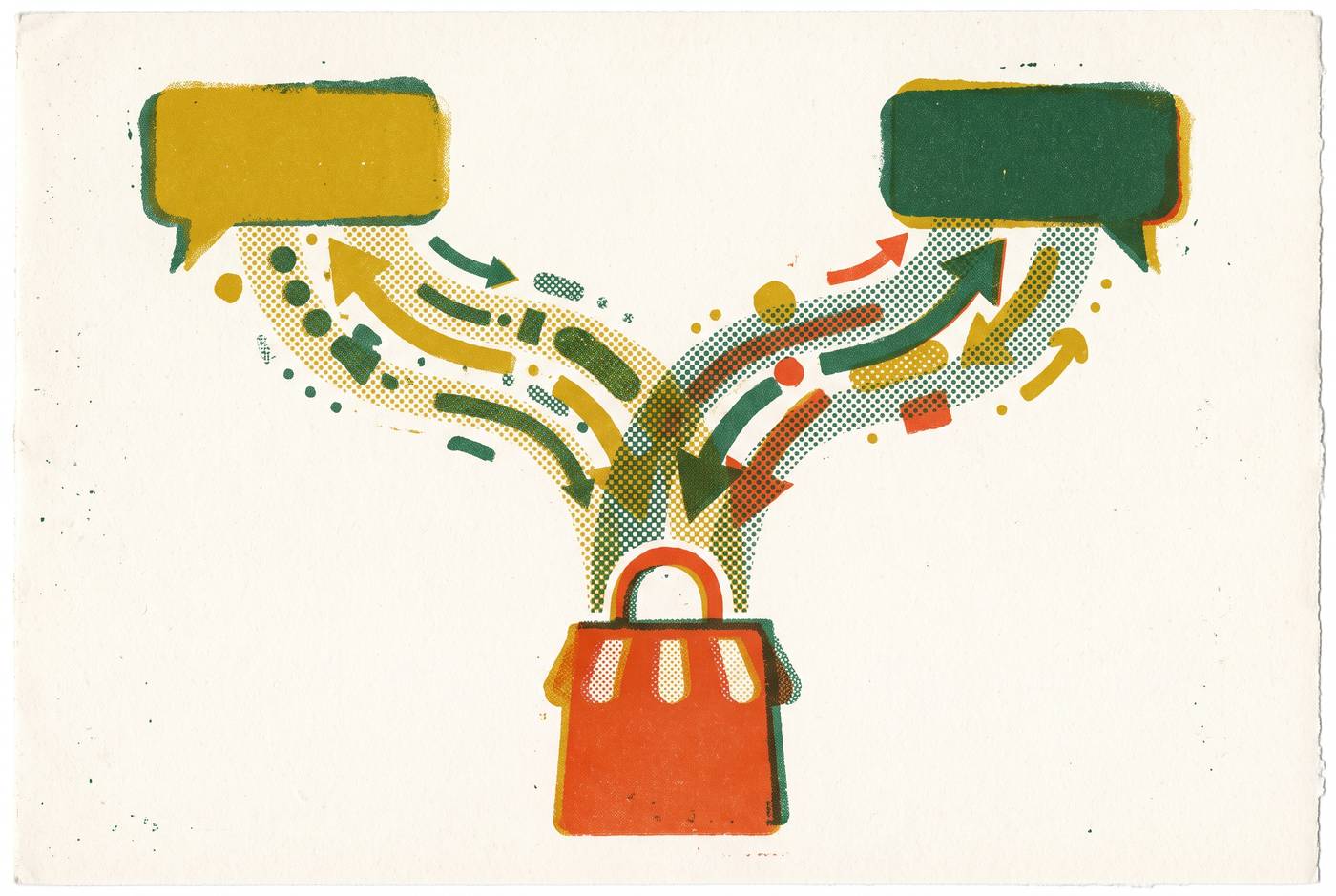
DTC brands are now running two acquisition systems at once, and the two operate on different logic. One is the stack built over the last fifteen years: paid search, paid social, a browse-based storefront where a shopper lands undecided and clicks around until something sticks. The other is a conversational discovery funnel, where a shopper asks an AI assistant a question, the assistant cross-references reviews, specs, and editorial coverage it has already indexed, and the shopper arrives at the brand's site having made most of the decision before the first page load. If you run the traditional funnel, you control discovery through bid strategy, creative, and search rank. In the conversational funnel, the AI has effectively done the comparison shopping the customer used to do across five browser tabs, so the person who lands on the product page has already been pre-qualified against a category and often against a shortlist of two or three options.
Because of that pre-qualification, conversion quality on AI-referred sessions tends to run well above average even while volume stays modest. The honest accounting matters here: AI assistants still account for a small share of sessions and revenue on established stores, and any claim that AI is already a dominant revenue channel does not survive contact with actual transaction data. What does hold up is a narrower, more defensible claim: this is the fastest-growing acquisition channel most brands have, and it is sending the best-converting new-customer traffic they get from any source.
The economics of that traffic shifted again in March 2026, when OpenAI deprecated Instant Checkout inside ChatGPT. With the original model, a shopper could complete a purchase without leaving the chat. The model now in place pushes discovery into the conversation and transaction onto the merchant's own site. The brand keeps the customer relationship: the login, the email capture, the loyalty enrollment, all of it stays on the merchant's domain instead of disappearing into a platform's checkout flow. A new funnel is forming alongside the old one, it is growing faster than most reporting credits it for, and it plays by rules that paid search and paid social never had to answer to.
ChatGPT and Perplexity: differences in audience, citation logic, and traffic
Treating "AI traffic" as one channel is the fastest way to misallocate a marketing budget, because ChatGPT and Perplexity reward different signals, reach different audiences, and send traffic with different conversion and order-value profiles. A brand can be the obvious answer on one platform and functionally invisible on the other, and the reason is not inventory or budget: the two systems are built to answer different questions in different ways.
Start with scale. The practical consequence is straightforward: a brand chasing reach should weight effort toward ChatGPT, while a brand selling into a higher-consideration, higher-price category should not treat Perplexity as an afterthought just because its raw numbers are smaller.
Citation logic is where the two systems genuinely diverge. A large share of ChatGPT's most-cited pages are sources no brand can buy or optimize its way into: Wikipedia, government and academic sites, major news outlets. Perplexity works differently again. It averages more than double the citations per response that ChatGPT generates, and it leans heavily toward linking out to websites rather than naming brands in the answer text itself, the reverse of ChatGPT's pattern. So a brand can get real referral traffic from Perplexity without ever being named in the answer a user reads, and that drives clicks but doesn't build the brand recognition a named citation would.
The two companies are also pulling in opposite directions on monetization, and the timing makes the split hard to miss. OpenAI launched ads inside ChatGPT in February 2026. Nine days later, Perplexity said publicly that it was walking away from advertising altogether, and framed the decision as protecting the trust that drives its Pro subscriptions. Two companies building competing AI shopping surfaces chose opposite monetization models in the same nine-day window, and that choice will shape what each platform rewards for years to come.
None of this happens in a vacuum, either. A content strategy built only for ChatGPT now covers meaningfully less of the AI traffic landscape than it would have a year ago. Each of these surfaces runs its own retrieval pipeline, its own ranking logic, its own citation convention, so a single piece of content optimized generically "for AI" will perform unevenly across all of them. The work has to be platform-specific because the platforms are not reading the same signals.
Why reported AI traffic numbers are systematically understated
Most brands are underestimating this channel because their own analytics are hiding it from them. The AI traffic that appears in a standard referrer report is a fraction of what is actually reaching the store, a structural gap caused by AI assistants that often strip or obscure referrer data, sessions that get misattributed to direct traffic, and conversations spanning a chat app and a browser tab that never leave the clean trail a paid search click does.
One signal survives that attribution breakdown reliably: the mix of new versus returning customers. A large majority of AI-referred revenue comes from first-time customers, but across a typical brand's full customer base, that figure is roughly half. That lopsided new-customer signature is still visible even when the referrer itself has been lost somewhere in the handoff between platforms, which makes it a usable fingerprint for a channel that otherwise hides from standard reporting.
Honest measurement means comparing AI-referred cohorts, identified through UTM tags and whatever referrer data does come through, against a brand's own baseline on conversion rate, average order value, and new-versus-returning mix, instead of reporting raw session counts and concluding the channel is too small to matter. The conversion and new-customer signals hold up where the volume signal does not. If a brand looks at a referrer report showing a handful of AI-driven sessions and decides the channel is negligible, it is making a real strategic decision on incomplete information. The channel is larger than the dashboard shows, and it's growing faster than the dashboard can currently track.
What controls whether a brand shows up in ChatGPT or Perplexity product recommendations
AI shopping surfaces don't run an auction the way paid search does. There is no bid to place and no slot to buy. Instead, these systems run pattern matching against structured signals, so the brands that show up consistently are the ones whose product data has been made legible to an AI retrieval system, not just built for a human who browses a collection page.
Structured data is the clearest entry point. Pages carrying schema markup correlate with higher citation rates in Google AI Overviews, though research hasn't established that the schema causes the citation. The honest read of that tension is that schema behaves like a prerequisite rather than a lever: it won't push a product into AI recommendations by itself, but its absence is common enough among ecommerce sites that implement product schema incorrectly to be a real barrier to entry.
Merchant feed quality sits next to schema as a second prerequisite, and each platform sources it its own way. ChatGPT Shopping pulls from several places at once: its own direct merchant feed program, Google's Shopping graph through partnership and crawl, Bing Merchant Center, Shopify, and general web crawling. Perplexity runs its own separate program, built on a Google Shopping-format CSV or XML feed, the spec Google Merchant Center itself uses. A feed that's gone stale or fallen out of sync will show the wrong price or an out-of-stock label even while the item sits in live inventory, and that kind of trust failure removes a product from AI recommendations no matter how well-written its content is.
Content has to shift register too. These systems favor products that answer a specific question over products that simply rank for a broad keyword, so a description optimized for keyword density can satisfy a Google crawler without ever answering what a shopper actually typed into ChatGPT. The practical test is to take each top SKU and ask what a shopper would type into an AI agent about it, then check whether the page answers that question with real use cases and real context. If most DTC brands rewrite those descriptions, it's by a wide margin the highest-leverage move they have not yet made.
Reviews function as a trust proxy on both platforms. The velocity of new reviews matters as much as the total count, so a brand actively growing its review base is building citation eligibility over time.
Third-party presence closes the loop, and here the two platforms diverge sharply again. ChatGPT's relationship with the same material is less stable: user-generated content dropped sharply out of its citation graph after updates in late 2025, and while more recent data shows it recovering, editorial coverage in trade and review publications has stayed the more reliable path to ChatGPT citation.
All of this converges on the product detail page itself. Roughly half of ChatGPT's ecommerce visitors land directly on a specific product page, deep-linked there by the assistant's recommendation, so they skip the homepage and the collection page. The product page is doing the work a homepage used to do, and for an AI-referred visitor, it's often the only page the brand gets to make an impression on.
How to sequence the work
The order of operations matters because these fixes sit on different timelines, and the platform that reacts fastest to technical correctness, Perplexity, is also the one where fundamentals pay off soonest.
Fix schema and feed accuracy first. This is the prerequisite layer, and it's the fastest to verify: check merchant feed sync status in both Google Merchant Center and Perplexity's own feed program, because a feed that hasn't synced correctly in months is quietly pulling a brand out of AI recommendations without any error message to flag it.
Rewrite product descriptions for conversational queries next. This is the medium-term layer, building its payoff gradually through accumulated effort. The payoff builds over several months rather than weeks, but it's durable, because conversational content serves a human reader on the product page at the same time it serves an AI retrieval system crawling that same page. For each top SKU, one paragraph should answer the three to five questions a buyer would actually type into ChatGPT or Perplexity: who the product is for, how it stacks up against the obvious alternative, and what makes it different.
Build third-party citation presence last: it's the slowest layer to move and the hardest to manufacture. For ChatGPT, editorial coverage in trade publications, review aggregators, and industry directories holds up better than user-generated content, which has swung sharply in ChatGPT's citation graph over the past year. For Perplexity, an active and accurate presence in the Reddit threads relevant to a category is a real lever: brands that earn organic mentions in those discussions get surfaced in Perplexity's shopping answers. Review velocity belongs in this layer too, as an ongoing effort rather than a campaign with an end date, because both platforms treat the rate of new reviews as a continuing trust signal, not a box you check once.
Measurement needs to start on day one, not after the first two layers are built. UTM tracking should go on every AI-referred session immediately, since ChatGPT's own tagging only offers a partial picture and needs new-customer mix and AOV alongside it to form a real fingerprint for the channel. Post-purchase experience feeds back into this system too: brands with fast, accurate automated support for order tracking, returns, and refunds show up more often in AI agent recommendations. The support function is now part of the discovery funnel.
That control is worth more now than it was before AI discovery existed, because every lever described above runs through data the brand itself owns.
What a brand intelligence layer does that disconnected fixes cannot
Most brands end up running this as four separate jobs. Someone fixes schema by hand. Someone else maintains the Perplexity feed on a different schedule. A third person rewrites product descriptions for conversational search in a workflow that never talks to the first two. A fourth tracks review signals somewhere else again, disconnected from all of it. Each piece gets done, but none of them share a foundation, so the brand is solving the same underlying problem four separate times with four separate owners and no shared source of truth connecting schema accuracy to feed status to content quality to review velocity.
That fragmentation is itself the failure mode. A feed can be perfectly synced while the product description it points to still reads like dated SEO copy. A review base can be growing while the schema markup behind it stays broken in a way nobody's checked in months. Each fix in isolation is necessary, and none of them alone is sufficient, because the AI systems reading this data don't evaluate a brand one signal at a time. They weigh structured data, feed accuracy, conversational content, and trust signals together, continuously, across every platform at once. A brand working from four disconnected workflows is always one gap away from invisibility on the surface that matters most to its customers that week.