Chat and Conversation Logs as Shopper Intent Research
Chat logs reveal what shoppers actually want, not just where they click.
Purchase intent used to live inside a search query. It now lives inside a conversation thread, and that migration changes what counts as a usable research signal for any brand selling online. Conversational commerce reporting for 2026 frames the shift directly: the defining change is a move from bots that answer questions to agents that act on them. The conversation itself has become the storefront rather than a support channel sitting beside it. A shopper's concern, their openness to a new product, and their readiness to buy now unfold inside a single thread, in sequence, where a human would once have scattered the same signals across several search queries and a string of retargeting cookies picked up along the way. That sequence never appears in a pageview log. ChatGPT Shopping sits between an enormous base of weekly users and the open web, and it narrows that traffic down to a handful of recommended products per query, so a brand is either inside that recommendation set or it isn't. There's no partial credit, so the conversations feeding it deserve to be read as research, not filed away as transcripts.
What a conversation log contains beyond a clickstream
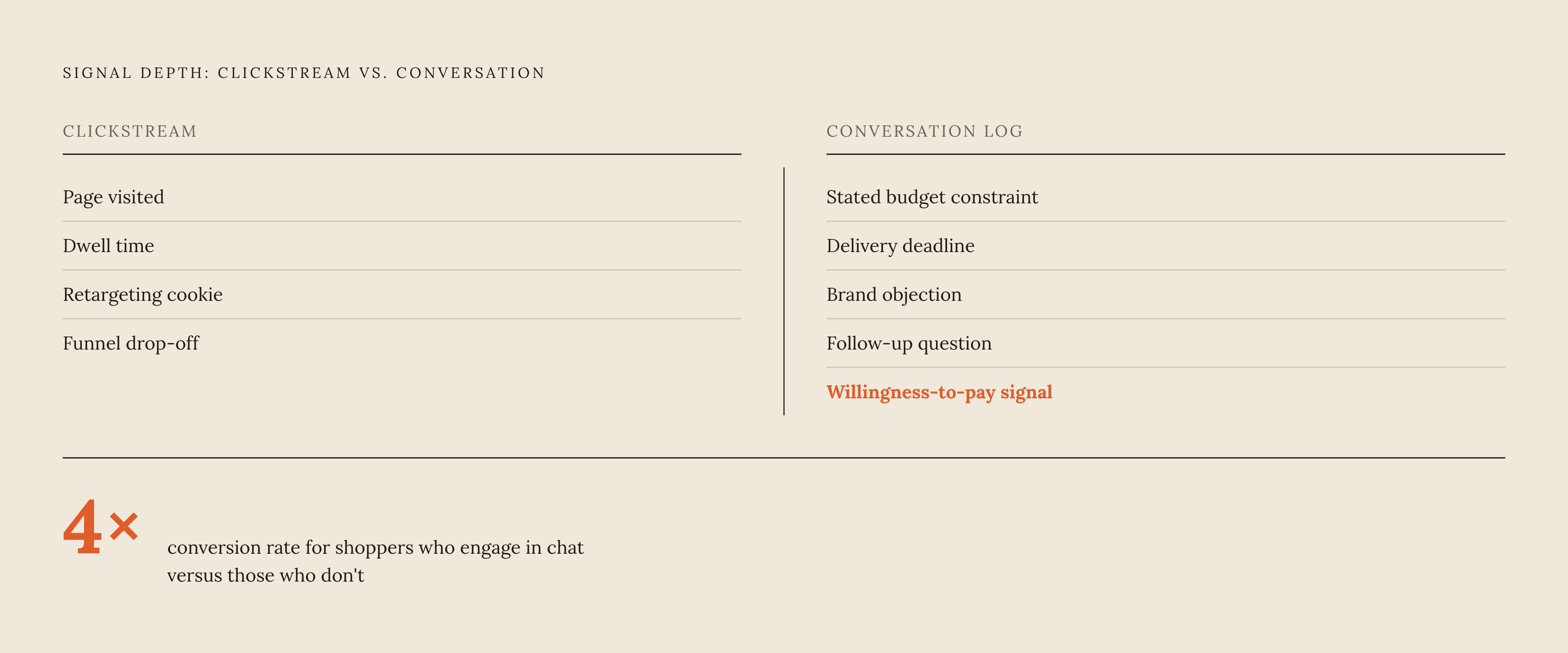
A clickstream tells a brand where a shopper went. A conversation log tells a brand what the shopper was thinking while they went there, in their own words, with the reasoning attached. You get that richer object because sequence and natural language sit together, and no session recording or funnel report carries both at once. Inside that transcript, certain patterns carry outsized weight. An action verb sitting next to a product category, something like "order," "get," or "find me," signals a shopper who has moved past browsing. Price or deal language functions as an actual filter the shopper is applying in real time, not just a page they happened to land on. If a shopper drops a specific brand or model name into a message, you know they already did their consideration somewhere else. A direct phrase like "where can I buy" states intent outright instead of leaving a brand to infer it from dwell time. And context clues around timing, phrases like "arrives Friday" or "before her birthday," push a message well past browsing into something closer to a deadline. A clickstream can record that a shopper visited a product page. Only a conversation log can record that the same shopper stated a constraint, got an answer, pushed back on it, and asked a follow-up question before deciding anything, and that sequence of statement, answer, objection, and follow-up is itself the research artifact a brand should be mining. Research from Alavi and Nozari (2026) on agent-to-agent commerce found that a buyer agent's dialogue with a seller recovers willingness to pay almost one-for-one just from the natural-language description involved. The conversation carries pricing information the shopper never typed out in dollar terms. That finding cuts in two directions at once. The same expressiveness that lets a seller infer what a shopper would pay is what makes these logs valuable for understanding what shoppers value and how much they'd give up for it. And the behavioral payoff backs this up at the conversion level: shoppers who engage in chat convert at roughly four times the rate of shoppers who don't, so a converting chat log isn't just a nice anecdote, it's a high-fidelity record of what actually tipped a real buying decision.
Chat logs as a support cost, not a research asset
Most ecommerce teams still measure chat the way they'd measure a call center: tickets logged, handle time, containment rate. Those metrics made sense when chat was just a support function bolted onto a storefront, a place shoppers went after something went wrong, not before they decided to buy. That framing is no longer accurate, and it's actively hiding value sitting in the same data those teams already collect. The brands growing fastest right now have flipped the measurement entirely: they track the chat window the way they'd track a storefront, in revenue per conversation, average order value, and attach rate, rather than in resolution time. The organizational reason this persists is straightforward. When a chat function reports into customer support, the incentive built into every manager's dashboard is to close conversations fast, and a team optimizing for speed has no reason to go back and read what shoppers were actually trying to accomplish or what stopped them from buying. Measurement grows harder to trust higher up the stack. Most analytics platforms simply can't see AI-agent-driven traffic yet, so revenue that originated in a conversation either disappears from the report entirely or gets misattributed to "direct," which makes a genuinely important channel look smaller than it is. That undercounting compounds further because individual platforms tend to claim full credit for a sale regardless of what else touched it along the way, so when a brand adds up revenue across its attributed channels, the total often exceeds what actually came in. A brand building strategy off those numbers is starting from a distorted baseline before anyone has even opened a single transcript.
Reading logs as structured research
To turn a folder of transcripts into research, you need a consistent set of questions to ask of every log, not new software and not a data science team. Four questions do most of the work. The first is what constraints the shopper actually brought with them, things like budget, a delivery deadline, compatibility with something they already own, or an occasion they're shopping for, all of which tend to appear in plain language in the transcript and almost never in a click trail. The second is where the shopper stalled or pushed back, since a thread that goes quiet or a question that gets repeated is usually marking a conversion blocker that the product page in question never resolved. The third is distinguishing what a high-intent session actually looks like from a browsing session, since action verbs, price language, urgency markers, and specific product references cluster differently depending on how close a shopper is to buying, and a brand can use that clustering to sort logs into intent tiers without any special tooling. A practical place to start is pulling two sets of logs side by side: sessions that converted, and sessions where the shopper dropped off right after the AI gave a product answer. The gap between those two groups, read closely, is the research itself. It also pays to understand how a system like ChatGPT Shopping is actually ranking what it shows a shopper: relevance to the stated need, including constraints most product pages never address, trust signals, the quality of the underlying structured data, availability, and price accuracy. If a product's feed can't answer a shopper's follow-up question, it gets filtered out quietly, with no error message and no warning to the brand that it happened. If a shopper asks something like "does this hold up on wet trails?" and the transcript shows the AI hedging or dodging the question, the feed is missing the data needed to answer it. The item exists, but the attribute that would have let the AI answer confidently simply isn't in the feed anywhere. Shopify's own data shows structured feeds converting roughly twice as well as scraped data, because a structured feed lets the AI actually answer the follow-up questions a scraped page can't, and reading logs is how a brand finds out exactly which questions its current feed is failing on. The format requirements are specific: the ChatGPT product feed needs core fields like item ID, title, a plain-text description, URL, brand, image, availability, and price, with optional fields like Q&A content and reviews adding further depth, and those optional fields are very often the exact ones a log analysis reveals are missing. Brands running on Shopify's Agentic Storefronts, announced in December 2025 and auto-enabled for US merchants on March 24, 2026, can get products surfaced inside conversations across ChatGPT, Microsoft Copilot, Google AI Mode, and the Gemini app, but only if the underlying feed can actually answer what those agents ask shoppers in the moment. Reading the logs is how a brand finds that gap before submitting a feed, rather than after watching recommendation frequency quietly drop.
A real caution: when logs reflect agent preferences, not shopper preferences
As buyer agents increasingly make the first pass of filtering decisions before a human ever sees a ranked list, agent behavior makes up more of what a conversation log contains, rather than pure shopper intent, and you can't treat the two as interchangeable. Alavi and Nozari (2026) document something they call a "role coherence" channel in agent purchasing behavior: the persona a shopper hands to their buying agent shapes how that agent shops, closely enough that a seller can infer the shopper's willingness to pay straight from the dialogue, even when no budget was ever stated. A log from an AI-mediated session is a blended signal, part shopper preference and part agent behavior layered on top of it, and reading it as a clean record of what the human wanted asks more of the data than it can actually deliver. The right response to that limitation is to triangulate rather than to give up on the method. Checking log signals against server-side order data confirms whether conversation-attributed intent actually turned into a sale. If a brand can tell human-to-AI sessions apart from agent-to-agent sessions and separates them, it keeps the cleaner signal, the human-initiated one, from being diluted by the noisier one. And treating agent-mediated logs as a record of what attributes the agent needed to make a decision, rather than as a direct window into what the human valued, keeps a brand from overreading supply-side information as demand-side truth. The same attribution honesty that applies to platform revenue claims applies here too: since platforms already tend to claim more credit than actual revenue supports, building strategy on conversation-attributed numbers without checking them against order data just adds a second layer of distortion on top of a measurement system that was already strained. None of this undercuts the method. It means a brand reading logs well asks which kind of session it's looking at before drawing conclusions from it.
Turning log intelligence into a compounding research advantage before the window closes
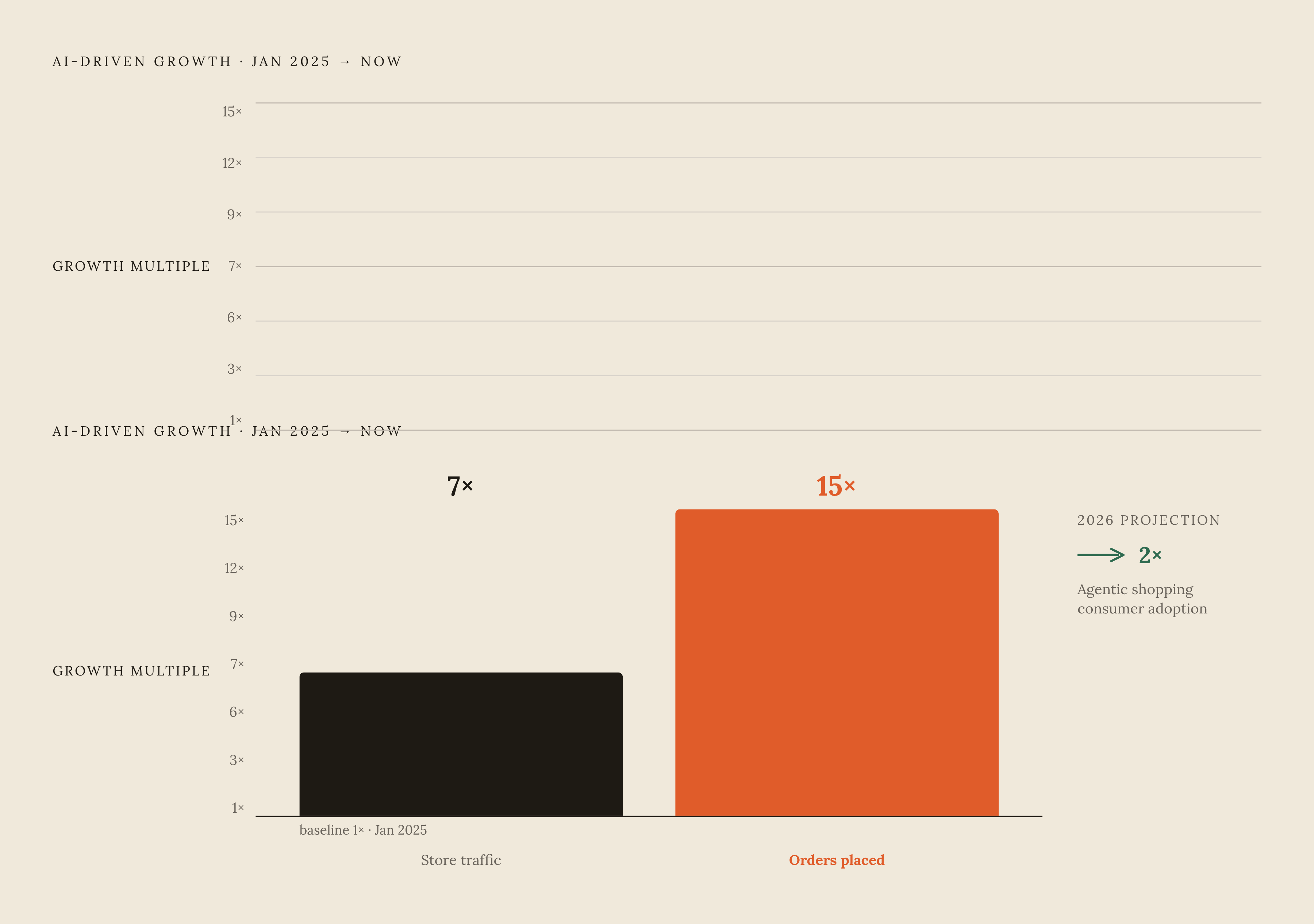
The advantage a brand builds from reading its logs doesn't stay flat, it compounds, because every session adds to a proprietary record of real shopper language and behavior, and a competitor who isn't reading their own logs simply has no access to it. The scale involved is already real: AI-driven traffic to Shopify stores grew seven times over since January 2025, and AI-attributed orders grew fifteen times over in that same stretch, putting the volume of conversation data most brands are sitting on well past the threshold where mining it systematically is worth the effort. The Braze Retail Customer Engagement Review projects that consumer adoption of agentic shopping will more than double by the end of 2026, so the logs being generated by today's early-adopter shoppers are effectively a preview of how the majority of buyers will behave within the year. Three steps turn that opportunity into practice rather than leaving it as an idea. Start by pulling and segmenting logs: separate converting sessions from drop-off sessions, and human-initiated conversations from agent-initiated ones, so you don't mix populations that behave differently. The 90-day window brands keep hearing about isn't a marketing flourish. Digital commerce is going through a real structural change in where intent gets expressed and how it gets acted on, so if a brand builds the habit of reading its own logs before most of the market even notices there's anything to read, it will hold a research advantage that's genuinely hard for a latecomer to buy or copy once the shift is complete.
Sources
- When Agents Shop for You: Role Coherence in AI-Mediated Markets
- How ChatGPT Shopping Works in 2026
- How to Detect Purchase Intent in AI Conversations (2026)
- Conversational Commerce as a Revenue Channel in 2026: Key Data and Trends
- Conversational Commerce in 2026 (Everything to Know)
- Chatbot Conversations Are Capturing Consumer Intent Before Brands Even Know It
- What Is Your AI Agent Buying? Evaluation, Biases, Model Dependence, & Emerging Implications for Agentic E-Commerce
- Conversational AI Commerce: Voice and Chat Revolution for DTC Brands in 2026