Referral Source Behavior Differences on DTC Landing Pages
Tailoring landing pages to each referral source's intent boosts conversions.
Referral source behavior differences on DTC landing pages explain why the same page can satisfy one shopper and lose another. Paid search, organic search, email, paid social, and AI referrals arrive with different intent, trust, and expectations. The practical conclusion is that page architecture, copy, and proof should match the visitor’s starting point rather than force every source through one optimized template.
Why the same landing page cannot serve every referral source equally well
DTC brands get traffic from more places while conversion rates can seem harder and harder to predict. An ad click, an email click, and an AI recommendation do not represent equivalent buying decisions. Each follows a different amount of discovery and persuasion before the visitor reaches the site. Treating them as interchangeable sessions hides the work the page still needs to do.
That difference begins before the first headline appears. A Google ad visitor expects a specific promise to be confirmed, while a promotional email subscriber expects access to an offer from a familiar brand. A shopper referred by ChatGPT arrives after a recommendation, unlike an organic visitor still establishing relevance. Consequently, a page that spends its opening explaining the brand may help discovery traffic but delay visitors who already have a reason to act. The structural flaw is not inadequate polish but a mismatch between the page’s sequence and the buyer’s position.
How paid search traffic arrives and what it immediately demands from a page
Paid search visitors arrive with an expectation shaped by the ad they clicked. Their immediate question is whether the destination delivers that benefit or offer. They also know they clicked an advertisement. That awareness raises their guard against oversell, so purchase intent does not eliminate the need for credibility. The page must confirm the promise and make it believable before asking the visitor to proceed.
The headline needs to align with the ad copy, the visuals need continuity with the creative, and the offer must retain the specificity of the campaign. Social proof that names who got a specific result makes the promise more believable than generic trust badges do. A badge alone supplies little reason to believe the claim. The useful proof addresses the expectation that brought the shopper to the page.
Routing paid clicks to a collection grid breaks this sequence. The ad featured a product, but the destination asks the shopper to find it again among alternatives. This is an architectural mismatch. A product detail page is a more direct destination, yet it can still fail when used unchanged across campaigns. Selecting the right product page does not remove the need to align its opening with the advertisement.
How organic search traffic differs from paid — lower intent, longer consideration, different trust signals needed
Organic search visitors often arrive to establish relevance. They have not received the framing that ad copy gives a paid visitor, so the page must supply more context. Their consideration process is usually less advanced. They may scroll, compare, and leave to check a competitor before they decide whether the product is right for them. Greater tolerance for navigation does not mean unlimited patience for friction.
Editorial and educational content can answer the question behind the query, while a founder story, methodology, or certifications can establish expertise. Internal navigation gives the visitor room to investigate. Those same features can distract paid visitors who want to go straight to the product in the ad. Organic search remains the dominant discovery channel by raw volume, but its lower conversion rate than paid search reinforces the distinction between audience size and readiness to buy.
How email traffic behaves and why it is the highest-trust, most context-sensitive source
Email visitors begin with a relationship the landing page should recognize. They have opted in, know the brand, and often arrive for a specific offer. Familiarity changes what the opening needs to accomplish. Introducing the brand to a subscriber who has bought three times spends attention on information already established. The failure is not an absence of trust but a page that ignores it.
Visitors from promotional campaigns focus on the offer and how soon they need to act, while visitors from automated flows arrive from welcome, post-purchase, or browse-abandonment sequences. Their context is more closely tied to a particular journey stage. Automated flows generate orders at a rate many times higher than broadcast campaigns because the trigger responds to demonstrated intent. That difference does not make every flow visitor a discount seeker.
A campaign click needs immediate confirmation of the email’s offer and a short path to the promised action. A post-purchase visitor may be more receptive to deeper content or cross-sell than an urgency-forward promotion. Both need continuity with the message that prompted the visit. Removing unnecessary reintroduction and checkout or sign-up friction protects the trust already earned without assuming that familiarity always means immediate purchase intent.
How paid social traffic behaves and why it needs the heaviest persuasion lift at the page level
Paid social visitors have the least purchase intent among paid channels because an advertisement interrupted them. Their low conversion rate follows from that starting point. The ad may have introduced a want they had not considered before scrolling, but awareness is not yet a buying decision. With no search query to establish relevance, the page must explain why the product belongs in the visitor’s consideration.
That burden makes continuity with the creative especially important. A visual or emotional break asks the visitor to reconnect with a different presentation before understanding the product. Storytelling, creator content, UGC, and community signals can extend the interest the advertisement created. The proof should feel native to the context. Generic trust claims do little to bridge the gap between an interrupted scroll and a considered purchase.
A hard “buy now” request can therefore introduce friction where it would serve a paid search visitor well. The social visitor may still need to learn more before they buy. Soft conversion paths give that interest room to grow while allowing for the work still needed to persuade the visitor. The appropriate page builds consideration from the reason the visitor stopped scrolling.
How AI-referred traffic differs from every other source — and why it arrives pre-qualified in a way no other channel produces
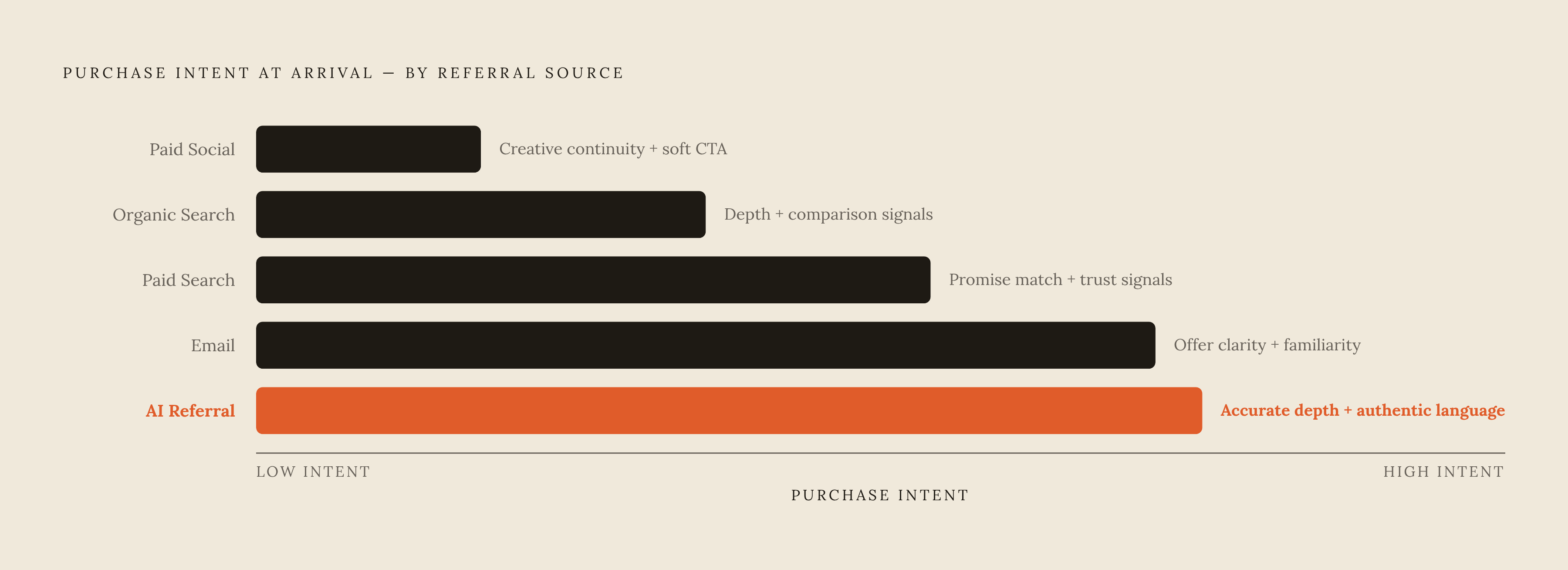
AI referrals compress the buying journey before the click. When ChatGPT, Perplexity, or Gemini recommends a product, the visitor has already received a relevance judgment, qualified their interest, and developed trust through the recommendation. They arrive to look into something they have already been told suits their needs. Unlike organic discovery, this visit follows help from an external system that has matched a need to a product. That borrowed trust changes the page’s primary task from introduction to validation.
Knotch data cited in Conductor’s 2026 benchmarks supports the broader finding that AI-referred visitors convert more readily than other site traffic. The benchmarks also report that these visitors spend 68% more time on-site, behavior consistent with deeper investigation after a recommendation. ChatGPT supplies the large majority of AI referral traffic, while Perplexity, Gemini, Claude, and others account for the remainder. These sources should not be assumed to produce identical behavior simply because they share a channel label.
For the landing page, the priority is to substantiate the specific use case or claim that prompted the recommendation. Structured, accurate product information supports that task, while vague descriptions weaken the connection between recommendation and evidence. Depth is useful here. Review content and community citations can reinforce the third-party validation that brought the shopper to the site.
AI referrals remain a small share of visits today, but their conversion quality and growth make volume alone a poor reason for inaction. Preparation also concerns discoverability. AI shopping channels read structured product attributes. Complete fields including GTIN, price, availability, material, size, and color, machine-readable schema, and real-time inventory sync form the foundation. Entity authority, third-party reviews, and content quality also influence whether the brand is cited.
Why copy quality on the landing page matters differently by source — and where AI-generated copy specifically fails DTC
Paid search visitors read first for offer confirmation, while organic visitors need context and evidence of expertise. Email visitors expect a familiar voice, and social visitors need a reason to move beyond awareness. AI-referred visitors are ready to look closely at product claims. Copy that succeeds in one of these roles may be poorly suited to another.
A 2026 study of 2,000 A/B tested pages found that AI-generated copy performed comparably to human copy on functional B2B pages but lost on DTC product descriptions and webinar landing pages. The DTC penalty followed detectable patterns. Em-dash overuse, generic adjectives, and phrases such as “leverage” and “optimize your experience” registered as untrustworthy. Human-voice copy drawn from customer reviews and real use cases performed better on DTC product pages because its language was specific and authentic.
An AI-referred shopper investigating details has more reason to read generic product language closely than a low-intent social visitor skimming the page. An email visitor may instead notice that the page sounds different from the brand voice they know. For paid search visitors, message match matters more from the start. These differences change the function of copy quality.
The same study found that named customer counts with specific scope outperformed generic logo strips and vague trust claims. Proof needs context to be persuasive. Its form should then follow the visitor’s frame, from social-native content for interrupted browsers to reviews and community citations for AI referrals.
Why brands cannot see the referral source behavior gap clearly — and how attribution gaps make the problem worse
Attribution can make channel behavior look more uniform than it is. Standard GA4 setups do not automatically place visits from chatgpt.com, perplexity.ai, or gemini.google.com into a clean AI channel. Much of that traffic lands in “direct” or “other.” Without custom groupings, the visible referral count is a lower bound on AI influence. Last-click reporting also cannot reveal influence that never produces a trackable click.
Platform self-reporting adds a different distortion. Ad platforms overstate their contribution to revenue, inflating paid performance relative to sources that do not claim credit for themselves. With branded search, it is especially easy to confuse attributed revenue with incremental revenue. Credit is not the same as additional demand. Treating the two as equivalent can direct both spending and page optimization toward paid channels while obscuring higher-converting AI visitors.
The practical response is more honest source segmentation. Custom GA4 channel groupings can isolate chatgpt.com, perplexity.ai, copilot.microsoft.com, and gemini.google.com as distinct referral sources. Post-purchase surveys can add to pixel-based attribution by asking what swayed shoppers beyond a recorded click. AI referral performance also needs comparison with the brand’s own engaged shopper cohorts rather than raw session totals from channels with different starting intent. Once those distinctions are visible, source-specific page design can be evaluated against the visitors it is meant to serve.
How to structure page decisions around referral source intent rather than a single optimized template
A source-intent matrix turns these behavioral differences into page decisions. Its purpose is to identify the visitor’s starting state and the next decision the page must support. For paid search, that means confirming the ad’s promise in the first three seconds, supplying specific proof, and shortening the path to the offered action. Organic search instead needs an answer to the query, evidence of expertise, and room for comparison.
Email requires a further distinction between campaign and automated flow arrivals, with offer confirmation separated from relationship-building content where appropriate. Paid social needs creative continuity, storytelling, social-native proof, and a softer route into consideration. AI referrals need accurate product depth, authentic language, and validation of the recommendation. These different priorities govern what appears first, which evidence supports it, and how much commitment the page requests.
Brands can do this without building five separate pages. With UTM parameters and referral source detection, a single product page can change its above-the-fold elements, proof, and CTA framing to suit the source. The first recommended change is simpler still. Fixing routing, especially paid and AI-referred visits sent to collection grids, should precede copy or design work because the destination must support the visitor’s purpose before its details can help.
An agent-ready storefront extends the product knowledge behind an AI recommendation into the on-site experience. As buyer agents increasingly select and purchase on consumers’ behalf, that foundation also makes product data legible to them. Richer structured data, a voice true to the brand, and on-site intelligence that works as a whole help with both uses. The work prepares the storefront to serve the intent arriving today and the purchasing systems that will increasingly act on it.